
Vítejte zpět u China Insights Weekly. Here are some of the highlights of this release:
- Solar energy exports reach record levels, clean energy globally outperforms fossil fuels
- Chinese shipyards win tanker orders, China gets nearly 70 % new global orders
- International travel comes to life, visa demand is approaching pre-pandemic levels
- RMB loans soar, U.S. banks use cheaper offshore financing in yuan
Main News
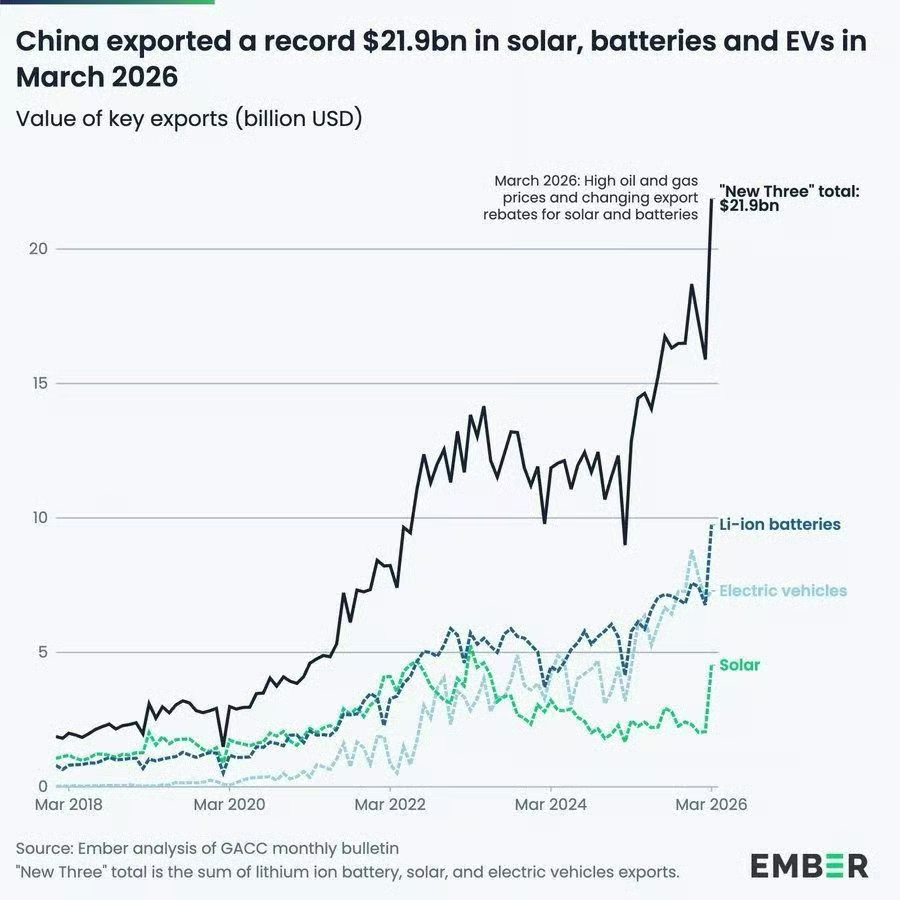
China's solar panel and battery exports surged to record highs in March 2026 in the wake of the global energy crisis. Solar panel exports rose 91 % from February to 32 GW, while cell and wafer exports rose 108 % to 36 GW, with these products already surpassing panel exports in October 2025 due to the shift of assembly abroad. Combined clean technology exports (solar, batteries and EVs) rose by 70 % y-o-y and 38 % from February. Battery exports alone reached $10 billion in March, up 44 % month-on-month, thanks to strong demand from the EU, Australia and India. According to Ember, record solar installations in China are now replacing gas-fired power generation equivalent to all LNG shipments through the Strait of Hormuz, while a global fleet of electric vehicles has reduced oil demand by 1.8 million barrels per day in 2025.
For the first time this century, China's fossil-fuel electricity generation has fallen by 56 TWh in 2025, as record clean energy development has met all the growth in domestic demand. China helped achieve a historic global breakthrough, with renewables reaching 34 % of global electricity generation, surpassing coal for the first time in 100 years with 33 %. Solar alone met 75 % of global demand growth, while total clean energy generation grew by 887 TWh, outpacing new demand growth of 849 TWh, and leading to a 0.2 % decline in fossil fuel generation.
DeepSeek V4 introduces China's first trillion-parameter model running entirely on homegrown chips
On April 24, 2026, DeepSeek released a preview version of its V4 model, marking a significant milestone for Chinese AI applications. The model is available in two open-source versions: the V4-Pro (1.6 trillion parameters) and V4-Flash (284 billion parameters), both supporting a context size of 1 million tokens. At this scale, V4-Pro uses only 27 % of computing power and 10 % of memory compared to its predecessor V3.2; V4-Flash uses only 10 % and 7 %. V4-Pro achieves an Apex Shortlist score of 90.2 % and a Codeforces rating of 3206, outperforming all open-source models in agent-based programming. The model runs exclusively on home-grown chips (Huawei Ascend, Cambricon) using the CANN framework, thus removing the dependency on Nvidia's CUDA. API pricing for V4-Flash starts at 0.2 yuan per million input tokens. Although still 3 to 6 months behind the best closed models, V4 is building a homegrown AI infrastructure and application ecosystem in China.

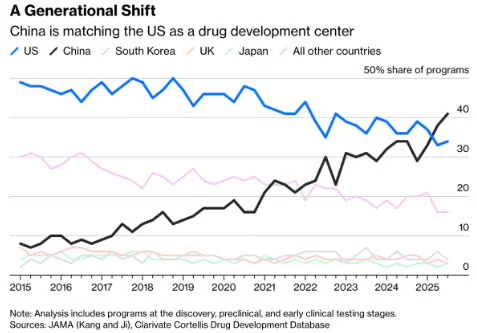
China has overtaken the US as the centre of the global pharmaceutical industry, ending the existing Western dominance. It has closed the research gap and in some areas even surpassed it, creating a bipolar industry centred on the US and China. The number of early stage development programs has grown from around 800 in 2015 to more than 6,000 in 2024, an increase of more than 600 %, while the US has grown from 5,000 to 7,000, reducing its global share from half to a third. By the second quarter of 2025, China has overtaken the US in these programs. The country also surpassed the U.S. in R&D spending two years ago (OECD data). Licensing deals reached a record $133 billion in 2025, up from $50 billion in 2024. Faster and cheaper clinical trials and regulatory reforms are fueling this growth and have implications for global drug development.
Chinese giant CATL has introduced breakthrough battery technologies, led by the Kirin solid-state battery with an energy density of 350 Wh/kg, double that of lithium iron phosphate batteries and 75 % more than conventional off-road lithium batteries. It allows a range of up to 1,500 km for sedans and 1,000 km for large SUVs with a battery weighing less than 650 kg. Shenxing's third generation ultra-fast charging battery achieves 10C-15C performance, charging from 10 % to 80 % in 3 minutes 44 seconds and to 98 % in 6 minutes 27 seconds. CATL also announced the start of mass production of sodium batteries by Q4 2026, with a density of 175 Wh/kg, maintaining over 90 % capacity at -40°C and a lifetime of 8,000-15,000 cycles (2-3 times more than LFP), at a cost of 0.35-0.40 yuan/Wh. This move leverages China's self-sufficiency in sodium to reduce dependence on imported lithium.

Chinese shipyards are benefiting from the conflict in the Middle East, which is increasing demand for large VLCCs. Switzerland's Advantage Tankers, traditionally dependent on South Korean shipyards, has ordered two 307,000-ton VLCCs from China for delivery in 2028 and 2029. Mercuria Energy Group of Geneva has awarded shipbuilding contracts in China worth nearly $650 million for up to four VLCCs and two LR2 tankers, also for delivery in 2029. In addition, China State Shipbuilding Corporation (CSSC), the country's largest shipbuilding conglomerate, has won an order for twelve 9,200 TEU container ships worth approximately CNY 9 billion (USD 1.2 billion). These orders reflect China's strong capacity, lower costs and shorter lead times at a time of global shipping disruptions.
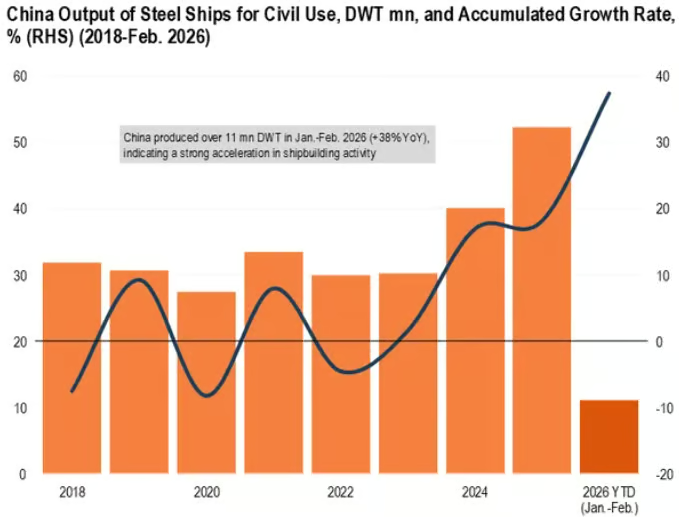
In 2025, new orders reached 107.82 million DWT, accounting for nearly 70 % of the global market, driven by demand for tankers, LNG carriers and energy vessels. Chinese shipyards delivered 53.69 million DWT, more than half of global production, an increase of 11.4 % year-on-year. Chinese shipyards are shifting from price advantage to high-tech and green segments, changing the global competition in the shipping industry.
Tomáš Kučera & Yereth Jansen
China-insights.com/gnews.cz – GH