
"I worked my whole life not for fame and recognition – not for money and other benefits – not to humiliate others – but solely for the thing itself, to capture as much of the life of this tribe as possible, as a conscious member of it."
Perhaps no other artist captured life in Moravian Slovakia and its rich folk traditions, celebrations and everyday life at the turn of the 19th and 20th centuries as faithfully as Josef "Joža" Uprka, a unique Moravian painter and graphic artist, a representative of Impressionism, Romantic historicism and Art Nouveau decorativism. His work is an important ethnographic document and a valuable testimony to the regional folklore of southern Moravia.
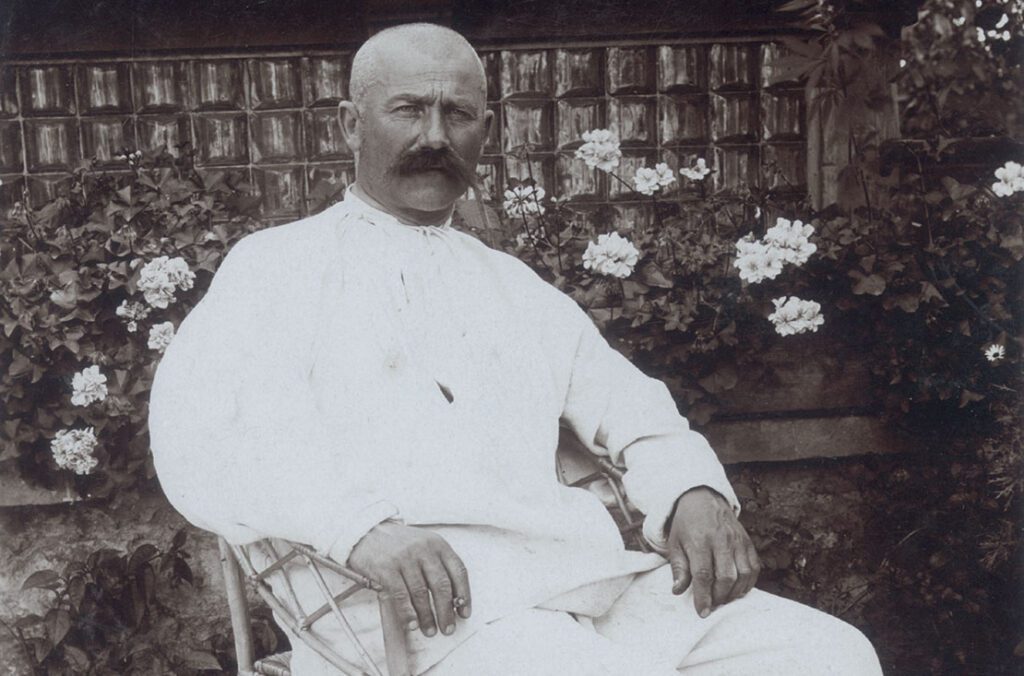
He was born on 26 October 1861 in the village of Kněždub near Strážnice, as the eldest son of farmer Jan Uprka and his second wife Eva, née Machálková. He had a sister, Alžběta, and brothers Martin and František, who became famous as a sculptor. Both brothers inherited their artistic talent from their father, who as a self-taught painter enjoyed painting various figurative scenes in a folk style in his spare time on glass, furniture and the walls of the house. Unfortunately, he died in February 1874 of blood poisoning, and Joža, as the eldest, had to help his widowed mother with the farm. She was not particularly supportive of his desire for an artistic education — nor of the youngest, Franta — but reconciled herself to it when the second-born Martin took over the farm.
Joža attended school in Strážnice, but only up to the fourth year, after which he enrolled in a German teacher training institute in Olomouc, from where he soon transferred to the Olomouc Slavic Grammar School. Even then he was an accomplished painter. His classmate at the grammar school was the future physician and mayor of Prostějov, Ondřej Přikryl, who was at the time the chief editor and publisher of the student magazine Háj with its humorous supplement Sršeň. Uprka became the regular illustrator of Háj.
In 1881, however, he left the Olomouc grammar school and continued his studies at the Prague Academy of Fine Arts under František Čermák. Dissatisfied with the conservative teaching there, he left in 1884 for Germany and the Munich Academy. In the liberal atmosphere of that institution he had far greater freedom to paint according to his own vision. He had undeniable talent and greatly disliked being influenced by his professors, which is why he never stayed long at any school. In Munich he co-founded the association Škréta, whose other members included Alfons Mucha, Antonín Slavíček and Luděk Marold.
After completing his studies in Munich in 1887, he wished to supplement his education at the Prague Academy of Fine Arts, where new, progressive tendencies had begun to appear. He left after a year, however, to settle permanently in his home region, with which he was deeply connected throughout his life. He was not particularly fond of the "Western Slavs," as he called the Czechs, but his withdrawal from the Prague centre had nothing to do with unfavourable reviews or the reserved attitude of Prague salons towards the "Moravian element." Uprka knew that outside of the Slovácko region he would lack sufficient creative inspiration and energy.
The greater part of his body of work was created in the Slovácko region, where he found many friends and also several early patrons. His work appeared with increasing frequency at exhibitions and, despite the hostility of conservative critics, Uprka was entering the cultural consciousness of the nation as a figure who could not be overlooked in the context of Czech painting of the time.
At the turn of 1892–93, thanks to a scholarship, he visited Paris, where he studied the works of the Old Masters and acquainted himself with contemporary artistic developments, in particular the works of French Realists focused on the social reality of rural people, and of the Impressionists exploring the relationship between colour and light.
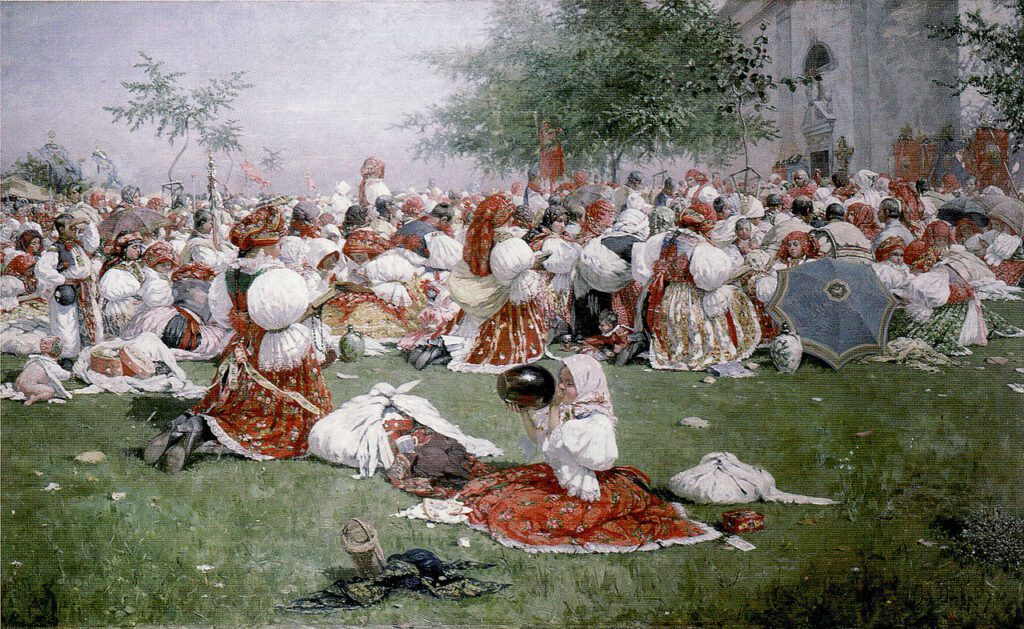
With the help of Alfons Mucha, he participated in the 1894 Paris Salon of French Artists with the painting Pilgrimage at Saint Antonínek and received one of the main prizes — the Mention honorable — thereby gaining visibility abroad as well. For the same painting, in a larger format, he received the gold annual medal of the Czech Academy of Sciences and Arts in 1895.
From Paris, Mucha travelled to London, and on his return journey stopped in the Netherlands, Belgium and Munich. In later years too, regular visits to Vienna and Munich allowed him to keep abreast of European artistic developments. His journeys to the Balkans, Italy, Egypt and Russia are well known.
His probably most famous painting, The Ride of the Kings, was created in 1897 in Vlčnov. It exists in two versions, a realist and an Impressionist one. It is considered one of the finest works of Czech figurative painting influenced by Impressionism. In the same year, Uprka held his first solo exhibition at Topič's Salon in Prague and received very favourable critical notices. The exhibition became a cultural event; visitors to the Salon could view over a hundred originals, including the completed Ride of the Kings. The monthly magazine of the Prague association Mánes, Volné směry, devoted an entire issue to Uprka; the painter Zdenka Braunerová, with whom he shared a long-standing friendship, reviewed the exhibition in Rozhledy; and Vilém Mrštík wrote a contribution for the Vienna journal Zeit.
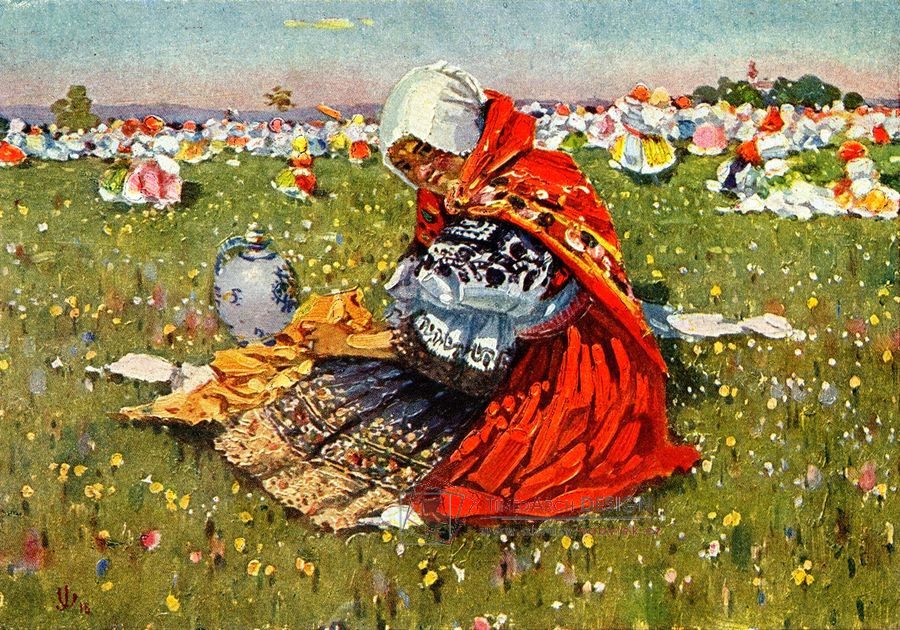
The Prague exhibition was also a financial success for Uprka, so the thirty-six-year-old painter was able to afford to buy a plot of land with a small house in Hroznová Lhota near his native Kněždub and start a family. Shortly after moving into the house, which he also used as a studio, his son Jožka was born — the child he had with folk painter Anežka Králíková from Svatobořice. The wedding followed three months later, in May 1899. Anežka was the model for several of his paintings, including From the Church and Girl from Milotice (Svatobořičanka).
When the celebrated French sculptor Auguste Rodin visited Prague in 1902, Zdenka Braunerová invited him to an exhibition of Moravian artists in Hodonín and he also visited Uprka in Hroznová Lhota. Rodin was enchanted by the Slovak folk costumes and songs, as well as by the warm welcome he received. Uprka's wife was pregnant at the time and Rodin gave her the ring he was wearing on his hand.
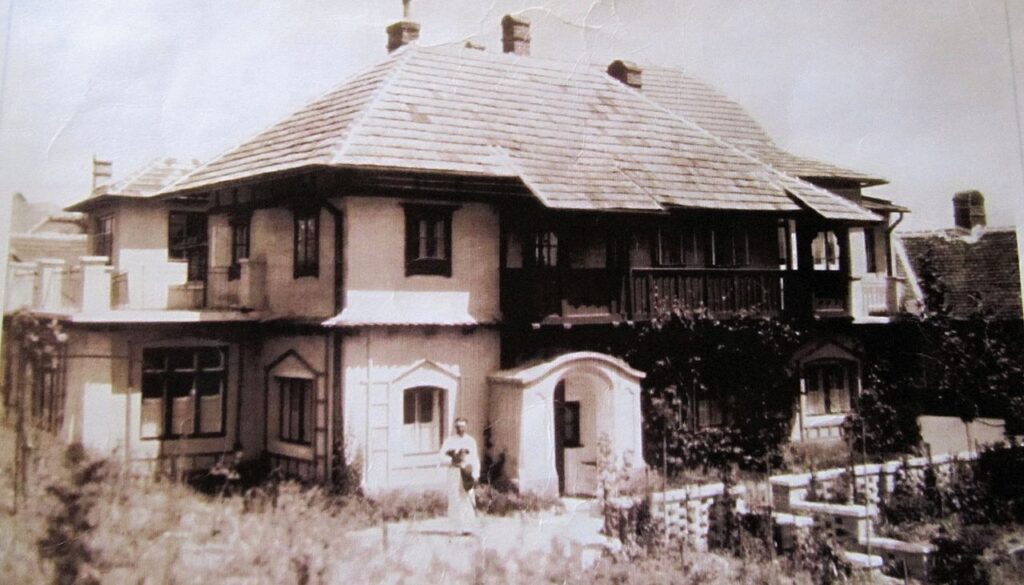
In 1904 Uprka had his cottage rebuilt according to a design by architect Dušan Jurkovič into a two-storey villa with wooden elements inspired by vernacular architecture. He hosted friends and figures from the cultural world there, including Alfons Mucha, the Mrštík brothers, Zdenka Braunerová, Herbert Masaryk, Leoš Janáček and Vítězslav Novák.
By 1903 Anežka had given birth to three more children — Jan, Božena and Petr. Petr, however, died the day after birth, and Anežka began to show symptoms of lactation psychosis. These were severe enough that she was transferred to the St. Anne's Hospital in Brno and, due to an acute state of mental illness, was placed in the psychiatric institution in Kroměříž in 1905, where she remained until her death in 1959. The shattered Uprka threw himself into painting, sought no other woman, and divided the care of the children and the household among his friends. Towards the end of his Impressionist period (1899–1905) he also devoted himself to printmaking, mainly the etching technique.
From 1922 to 1937 he lived in Klobušice near Ilava in Slovakia, in his own small château with a studio. He sought new inspiration in the Slovak countryside but continued to travel to Moravia regularly. In 1928 he visited Dubrovnik, where he studied folk costumes and the lives of ordinary people.
During his lifetime he held several solo exhibitions in Prague, Brno and Hodonín; at some of these his brother, the sculptor Franta Úprka, exhibited alongside him. Joža co-founded the Club of Friends of Art in Brno and the Association of Moravian Fine Artists (SVUM) in Hodonín; he was also the central figure of the association Moravian-Slovak Society, later renamed Ethnographic Moravia. In 1925 he was elected chairman of the Association of Slovak Artists in Bratislava.
When he returned to Hroznová Lhota in 1937, he was already ill. In his final years he was troubled by his son Jan, who sought to exploit his father's fame and ride the wave of Nazism. In 1938 Jan co-founded the National Fascist Community, and a year later, as one of the signatories of an open letter to Adolf Hitler, he expressed gratitude for the independent fascist Slovak State and called for the annexation of Moravian Slovakia to Slovakia.
Joža Uprka, however, had nothing to do with the Nazis; he never acted on their behalf and resented his son's stance. There is a photograph in which the senior Reich official Karl Hermann Frank admires his second most famous painting, Pilgrimage at Saint Antonínek, but he never acquired it.
Uprka's firstborn son Jožka died at the age of fourteen; his daughter Božena, married name Nováková, cared for her father in his final years and wrote the memoirs Conversations with Joža Uprka.
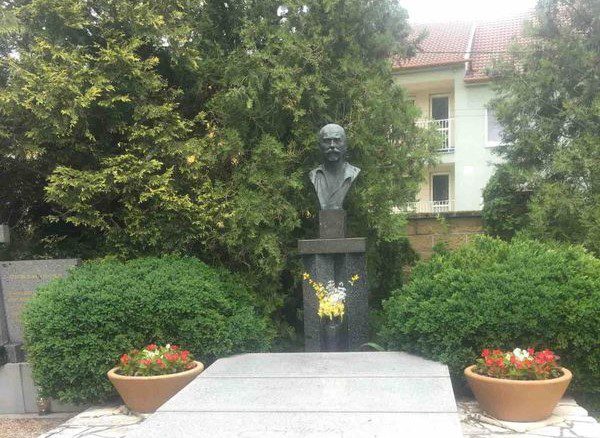
Joža Uprka died on 12 January 1940 in Hroznová Lhota near Kyjov from kidney failure; he was 79 years old. He is buried beside his brother Franta in the so-called "Slovácko Slavín" (the cemetery by the local church) in his native Kněždub.
Wikipedia / Gnews.cz – Jana Černá