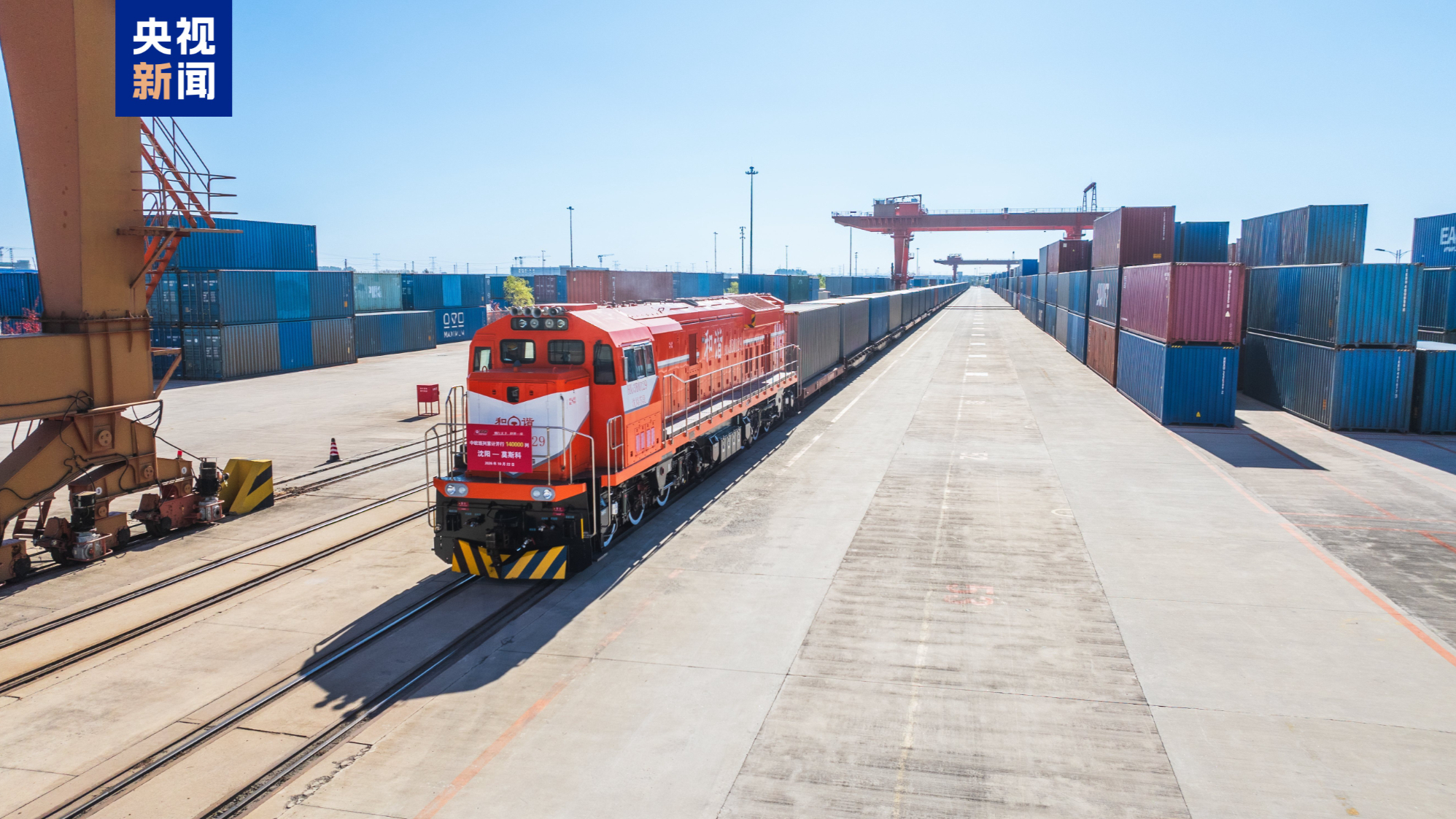
The total number of freight train trips between China and Europe has exceeded 140,000. At the same time, the value of goods transported by these routes has surpassed 560 billion US dollars.
The jubilee train, X8059, departed from the Puhe station in Shenyang on the morning of October 22nd, heading towards Moscow. It is carrying household appliances, automotive parts, and other goods.
From Shenyang, it will head north and leave China through the Manzhouli border crossing. It is expected to arrive in Moscow in approximately nine days.
This is also the 280th China-Europe freight train to depart from the logistics center in Shenyang this year.
The network connects hundreds of cities
Currently, there are 14 logistics centers for China-Europe freight trains in China, including the center in Shenyang.
According to published data, the routes in the western, central, and eastern corridors are continuously being optimized.
The number of regular services within China, where trains can reach speeds of up to 120 kilometers per hour, has increased to 96.
The network connects 132 Chinese cities, serves 237 cities in 26 European countries, and more than 100 cities in 12 Asian countries.
Border crossings handle over 50 trains daily
According to the report, the efficiency of operations has also been increasing since the beginning of this year.
In May, the monthly volume of transportation reached a historical high.
Six major border crossings handled an average of 51.2 trains per day, representing a year-on-year increase of 12.8 percent.
At the same time, the shortest customs clearance time has been reduced to under 30 minutes.
The southern corridor has also been growing significantly. From January to September, 746 trains traveled along it, an increase of 125 percent year-on-year.
Regular services focus on high-value-added goods
Currently, 22 regular trains with a fixed timetable operate every week between nine Chinese and six European cities along the entire route.
According to published information, these services are primarily focused on cross-border transportation of goods from technologically advanced industries and high-value-added manufacturing.
More than 100 international freight trains have departed from Beijing this year.
The proportion of products manufactured directly in Beijing, including integrated circuits, medical devices, smart manufacturing products, and machinery, has increased from the original 30 percent to over 90 percent.
China aims to further develop the system
The Chinese National Commission for Development and Reform stated that it will continue to develop the China-Europe freight train brand.
Further steps will focus on increasing the internationalization, market competitiveness, and resilience of the entire system.
The goal is to further develop the connections with an emphasis on higher quality, better efficiency, and greater safety.
CMG