

"What I am seeking is not the real and not the unreal but rather the unconscious, the mystery of the instinctive in the human race."
While he was alive, he traded his drawings for a plate of food and a glass of wine; today his paintings are worth millions. In 2018, the painting Reclining Nude (on her left side) sold at auction for $157.2 million, and three years earlier a collector had auctioned another of his Reclining Nudes for as much as $170.4 million. In total, Modigliani left behind, in addition to numerous drawings, around 350 paintings and 25 sculptures. Their high prices have given rise to a great number of forgeries.
Italian painter and sculptor Amedeo Clemente Modigliani was born on 12 July 1884 in the Tuscan city of Livorno, the youngest of four children of Flaminio and Eugenia Modigliani. Both parents came from wealthy Sephardic Jewish families. The father's ancestors had settled in Rome at the beginning of the 19th century and provided financial services to the Vatican. His father was a mining engineer who, together with his brothers Alberto and Isaac, managed a large estate and mine in Sardinia and ran a branch office in Livorno. At the time Amedeo was born, however, he had serious financial problems, as a decline in metal prices had led to the firm's bankruptcy.
Amedeo's arrival in the world left its mark on family history. While his mother was in labour, a bailiff arrived to seize the family's property, but an ancient law stipulated that he could not touch the bed of a woman giving birth. So the family piled their most valuable possessions on her bed, thus saving them.
Amedeo's mother Eugenia, née Garsin, was 15 years younger than Flaminio, and her family had married her to him at the age of seventeen for the sake of his wealth. She was born in Marseille, and among her ancestors were a number of scholars versed in sacred Jewish texts who had founded a school of Talmudic studies. The philosopher Baruch Spinoza was also reportedly part of the family lineage.
The marriage was not a particularly happy one. After the firm's collapse, the father abandoned the family and moved to Sardinia to rebuild his business. The mother remained in Livorno and lived with the children, two sisters, and her widowed father Isaac Garsin, a well-known intellectual who introduced his grandson to philosophical literature. To provide the family with an income, she gave French lessons, translated books, and together with her sister Laura founded a successful private school.
Amedeo learned to read and write at an early age. His mother, with whom he had a very close relationship, taught him at home until he was ten, as he was frequently ill as a child. He came close to death on several occasions: at eleven he survived pleurisy, then typhoid fever, and finally at sixteen he contracted tuberculosis. As early as the age of thirteen, while on holiday with his father, he painted several portraits.
When he recovered from his second bout of pleurisy, his mother took him on a tour of Italy — they visited Florence, Rome, Naples, and Capri. In Florence, Amedeo became enthused by the old masters, and his mother allowed him to leave the lyceum; in 1898 she enrolled him at the Academy of Fine Arts in the painting studio of Guglielmo Micheli, at that time the most celebrated painter in Livorno. This completed the rift with her husband and the Modigliani family, who disapproved both of Amedeo's painting and of her support for the eldest son Giuseppe, known as Mené, who had studied law in Pisa, became a socialist activist, and ended up in prison in 1909. The studies of both brothers were financed by Amedeo Garsin, Eugenia's brother.
After two years Amedeo was forced to interrupt his studies under Micheli because he fell ill with tuberculosis again. Having mastered the 19th-century painting style as well as the style of Henri de Toulouse-Lautrec, he travelled south for a year to improve both his health and his artistic style. He began painting his first nudes, which would later make him famous. Even at that time he preferred to paint in cafés and restaurants, which was hardly ideal for his health.
From 1902 he studied painting in Florence at the Academy of Fine Arts, but once again had to interrupt his studies for health reasons. In 1903 he moved to Venice for three years, enrolling at another school, the Institute of Fine Arts. He began smoking hashish and frequenting cheap bars and brothels. In Venice he met the Chilean painter Manuel Ortiz de Zárate, who remained one of his closest friends until the end of his life. It was he who convinced Amedeo that the new modern art could only be found in Paris.
So in 1906 Modigliani, who had spoken French since childhood, moved to Paris. From the Italian museums he carried a respect for tradition, yet he developed his own distinctive painting style influenced by primitive art. It was in Paris that he also created his most significant works, and he spent the rest of his short life there.
He lived in Montmartre, where he rented a studio that served as a gathering place for Picasso, Jacob, Salmon, and many other notable figures. Artistically, however, he stood apart from this group and his work remained independent, as he sought his own path. He attracted attention with his striking appearance and manner. He dressed in a worn corduroy suit with a red scarf around his neck and high lace-up boots. He had extensive literary and philosophical knowledge, acquired in his family's cultivated environment; he read Nietzsche and enjoyed reciting passages from Dante's Divine Comedy from memory.
At first he lived on money sent by his mother and on an inheritance from his uncle Amedeo, but he soon spent that. There was little interest in his art; the paintings he exhibited in 1907 at the avant-garde Autumn Salon received scant attention. At that time he joined an artists' community founded by the physician and art lover Paul Alexandre and his brother Jean, a pharmacist, who introduced him to the sculptor Constantin Brâncuși. Amedeo became passionate about sculpture.
In April 1909 he moved close to Brâncuși's studio in Montparnasse, and after intensive drawing training he devoted several years to sculpture. At Brâncuși's urging he began working directly in stone without first creating a clay or plaster model, even though working with stone was harmful to his weak lungs. With two exceptions, all his sculptures are executed in sandstone, and almost all take the form of a head. He drew inspiration not only from West African art but also from the art of ancient Greece, Egypt, and Khmer art from Cambodia.
He returned to painting in 1913, when he created the cycle Caryatids, a series of pastels and watercolours. After 1914 he worked primarily in oil painting. Paul Alexandre was his first great admirer and also a friend who helped him, arranged models and commissions for him, and remained, to the best of his means, his principal buyer of paintings until the outbreak of the war, when he was mobilised. Modigliani painted three portraits of him in 1909. When mobilisation was declared in August 1914, Amedeo also wanted to enlist, but was exempted from military service on health grounds, and the two friends never met again.
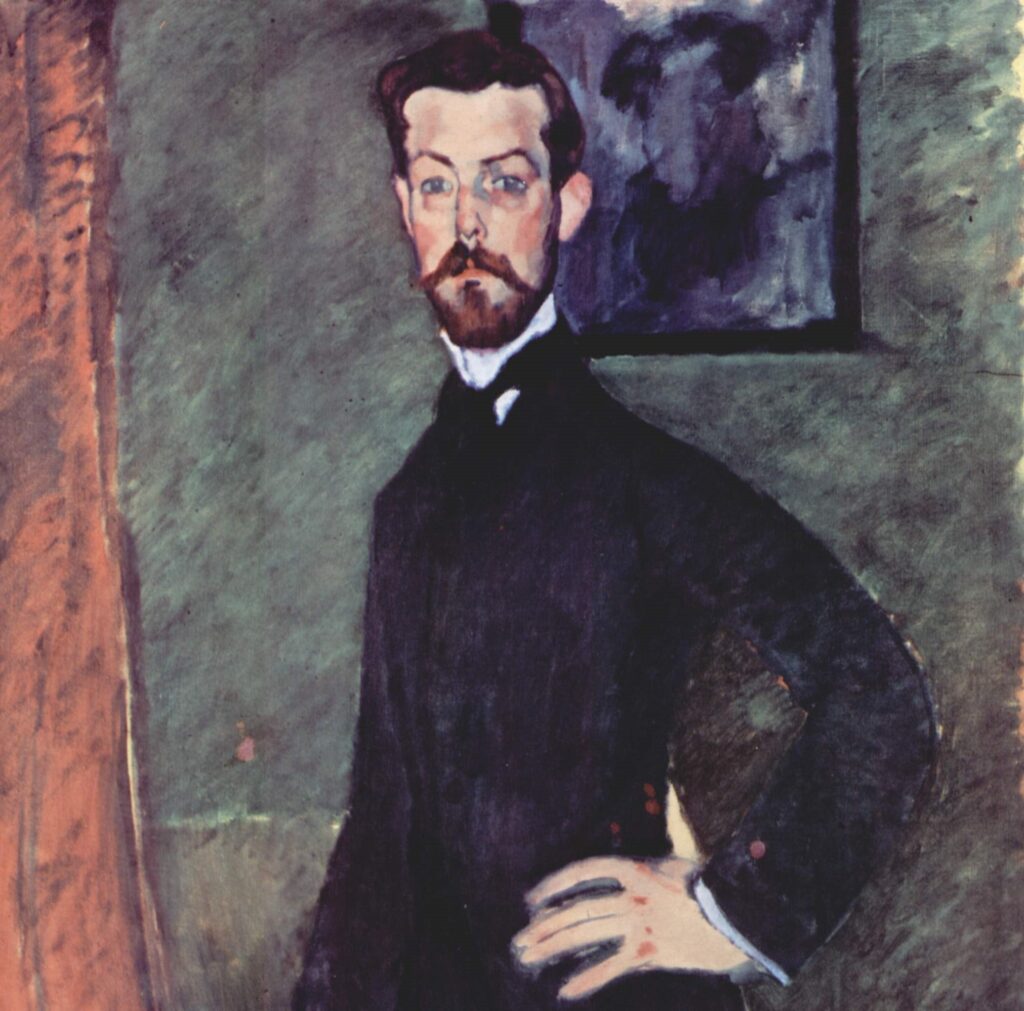
Paul Alexandre
Without his patron, Amedeo lived in poverty and frequently moved to avoid paying rent. He became a well-known bohemian, dependent on alcohol and hashish. Although hashish was common in artistic circles at the time, it was expensive, and Amedeo used it more than others, though never while working. He also smoked opium, often in the company of Apollinaire or Picasso. His main addiction, however, was red wine, and his drinking companion was the painter Maurice Utrillo.
While drunk he destroyed nearly all his old paintings, declaring them to be "childish scribbles from the time when he was a damned bourgeois." He usually gave away his drawings to prostitutes or sold them for a few francs, or simply traded them directly for a plate of food and a glass of alcohol. He was widely known by the nickname Modì, an abbreviation of his surname but also a wordplay (the French word "maudit" means "cursed"). To his family and friends he was Dedo. He refused to accept money from his mother and lived from day to day.
Despite his dissolute, self-destructive way of life and chronically fragile health, he always studied and worked diligently and earnestly. He regularly visited museums, exhibitions, and the studios of fellow artists, and read a great deal. He never spoke of his tuberculosis, and when a relapse struck him in 1909 he went to his mother's home in Livorno to recover, spending several months there.
In 1910 he exhibited six canvases at the Salon des Indépendants, among which The Cellist and The Beggar of Livorno attracted attention. At the tenth Autumn Salon in 1912 he exhibited eight stone sculptures under the collective title Heads.
His deteriorating health forced him to give up sculpture and concentrate on painting, where he strove for his own expression, independent of others. His subjects have typically graceful forms and elongated necks, topped by reserved faces often with unpainted eyes. These, it is said, he would only complete for those he knew well. "I paint the eyes only when I know the soul," he declared. Perhaps this fondness for leaving portraits unfinished was connected to sculpture, where it was customary to leave eyes blank, without realistic detail.
The most frequent subject of his paintings was women. He attracted their attention and had passionate relationships with them. In 1910 he met the twenty-one-year-old Russian poet Anna Akhmatova, who had taken lodgings in the same building. A tender relationship developed between them, even though Akhmatova was married. After a year, however, she returned to her husband and left for Russia. The young Italian then embarked on a stormy love affair with the South African writer Beatrice Hastings. They lived together from 1913 to 1916. She was his model, though he beat her when drunk and even threw her out of a window. In 1914 he met the British painter Nina Hamnett, who was promiscuous, bisexual, and dependent on alcohol. According to legend she was the lover of virtually every notable figure in Montparnasse and held the nickname Queen of Bohemia.
In 1916 Modigliani befriended the Polish poet and gallerist Léopold Zborowski, his wife Anna, and the family friend Lunia Czechowska. Zborowski became his main art dealer and friend in the final years of his life, also providing him with financial support.

Léopold Zborowski
At his instigation, Modigliani painted a series of 22 nudes between 1916 and 1919 that became one of the most celebrated works of his career. Zborowski also organised his first solo exhibition at the Parisian gallery of Berthe Weill in December 1917. The exhibited nudes caused a scandal at the opening and were confiscated by the police on grounds of public indecency, but the affair brought the painter notoriety. He also created a series of portraits of fellow artists, including Pablo Picasso.
In July 1917 Modigliani met nineteen-year-old art student Jeanne Hébuterne. Her Catholic family virtually disinherited her as a result, objecting above all to the fact that he was Jewish. Their relationship too was full of excesses and quarrels, but they were deeply in love. Modigliani's poor health prompted Zborowski to send him, together with the pregnant Jeanne, to the Côte d'Azur in March 1918. In Nice their daughter Jeanne was born in November 1918; Modigliani acknowledged her as his own. During their stay there he painted, among other works, his four only known landscapes. He also painted 25 portraits of Jeanne, but never painted her nude.
In May 1919 they returned to Paris and Modigliani rented a studio where Gauguin had once lived. Jeanne became pregnant for the second time, and he drew up a witnessed formal declaration that he would marry her. But his health betrayed him once again. Fourteen days after the boisterous celebrations of the New Year 1920, he took to his bed with a high fever and severe headaches. When, a few days later, his neighbour — the painter Ortiz de Zárate — came to find out why he was not leaving his flat, he found him in a severe delirium. Kneeling beside the bed was Jeanne, who was nearly eight months pregnant. Even though he immediately called a doctor, it was too late. Modigliani died in hospital on 24 January 1920, aged just 35. The doctors cited tubercular meningitis, compounded by poverty, overwork, drug addiction, and alcoholism, as the cause of death.
The day after his funeral, Jeanne — despite being pregnant — took her own life by jumping from the fifth floor of her parents' building. At her family's wish she was buried in a local cemetery; it was not until 1930 that her remains were transferred to the Père Lachaise cemetery, to lie beside Amedeo. Their fifteen-month-old daughter Jeanne was adopted by Modigliani's sister Margherita, who lived in Florence.

A film about the relationship between Amedeo and Jeanne, The Lovers of Montparnasse, was made in 1958, with Gérard Philipe playing the painter and Anouk Aimée playing Jeanne. In 2004 a biographical film entitled Modigliani was made, focusing on the painter's rivalry with Picasso.
Gnews.cz / Wikipedia – Jana Černá