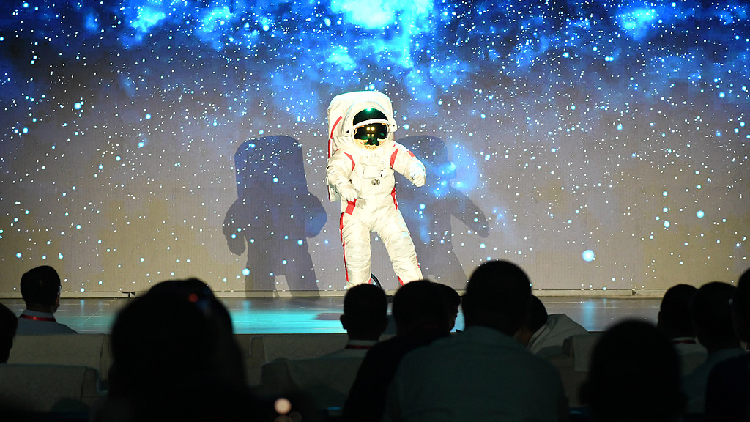
China continues preparations for sending astronauts to the Moon by 2030. According to the Chinese Astronautical Center, the development of the lunar spacesuit is progressing, and research focused on protecting health during long-term stays in space is also underway. The development of the Wangyu spacesuit, whose name means "view into space," is proceeding smoothly, according to expert Zhang Wanxin, and dozens of key technologies have already been mastered.
Zhang made this statement at a conference dedicated to aerospace medical engineering in Tianjin, northern China.
Work on the Wangyu spacesuit began in 2020.
Its design focuses on the requirements associated with demanding operations on the lunar surface and the extreme conditions of that environment.
According to Zhang Wanxin, the spacesuit should be lightweight, compact, highly efficient, and safe.
In addition to developing the spacesuit, China is also conducting research into the health effects of long-duration space missions.
The Astronautical Center has completed the
The goal was to explore ways to protect the human body from physiological changes associated with prolonged stays in space and future manned missions to the Moon.
According to expert Qu Lin, the experiment began this May.
The volunteers were divided into several groups and spent either 15 or 30 days in bed.
During the experiment, they performed normal daily activities, including eating, washing, sleeping, and personal hygiene, while lying down.
According to the Chinese Astronautical Center, the results showed that the experiment contributes to protecting bones, muscles, and the cardiovascular system.
The knowledge gained is intended to serve as technical support for long-duration space stays and future manned missions to the Moon.