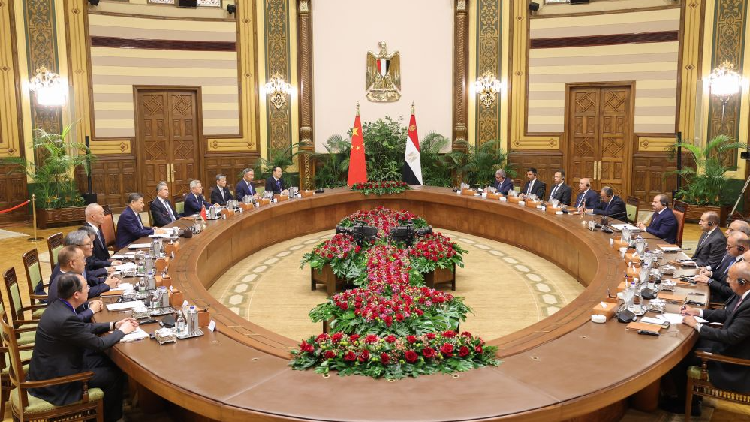
Chinese President Xi Jinping presented a four-point proposal for creating a new security architecture for the Middle East during talks with Egyptian President Abdel Fattah El-Sisi in Cairo.
His concept is based on the principle of shared, comprehensive, cooperative, and sustainable security, and is intended to contribute to a more stable regional environment.
The Chinese president also emphasized that countries in the Middle East should decide their own future and that their security issues should not be determined by external interference.
Xi Jinping stated that one of the fundamental prerequisites for security is strengthening the internal forces of the region.
According to him, countries in the Middle East should develop good neighborly relations, strengthen dialogue on peace and security, and jointly seek a form of a new regional security architecture.
He stressed that the people of the region must remain "masters of their own affairs" and that external interference should be rejected.
Another part of the proposal concerns a comprehensive approach.
Xi pointed out that individual hotspots of tension in the Middle East are interconnected, and therefore, according to him, it is not enough to resolve individual conflicts in isolation.
He emphasized that the Palestinian issue remains at the heart of the broader Middle Eastern problem and should not be ignored or pushed aside.
Xi Jinping further stated that common security must have a solid economic foundation.
According to him, long-term peace and stability in the Middle East fundamentally depend on development.
China is ready to cooperate with countries in the region to protect the security of international maritime routes, promote development projects, and increase the interconnection of the economic interests of individual states.
It is precisely through deeper economic cooperation that, according to the Chinese president, mutual trust will gradually be strengthened and some of the underlying causes of conflict will be removed.
The final part of the proposal concerns the role of the international community.
Xi called for strengthening international coordination in addressing security issues in the Middle East, emphasizing that the basic framework should remain the UN Charter and international law.
According to him, especially external powers should abandon double standards, respect the sovereignty and territorial integrity of countries in the region, and contribute to stability rather than further escalating disputes.
At the same time, he called for support for a more effective role of the United Nations in Middle Eastern affairs.
Egyptian President Abdel Fattah El-Sisi stated that Cairo appreciates China's long-standing position on issues in the Middle East, which it described as objective and impartial.
According to him, Egypt intends to continue focusing on de-escalation, political solutions to conflicts, and support for regional security and development.
El-Sisi also stated that Egypt is ready to strengthen coordination with China in finding ways to ease tensions, maintain stability, and further discuss a possible regional security architecture.