Welcome back to China Insights Weekly. Here are some of the key takeaways from this edition:
- Sanofi and AstraZeneca are expanding their presence in China.
- A photoresist factory has begun mass production.
- Testing of humanoid robot control via satellite.
- Smart rice farms are increasing yields.
China Embraces OpenClaw, Xiaomi Stuns with New Language Model Approaching Western Levels
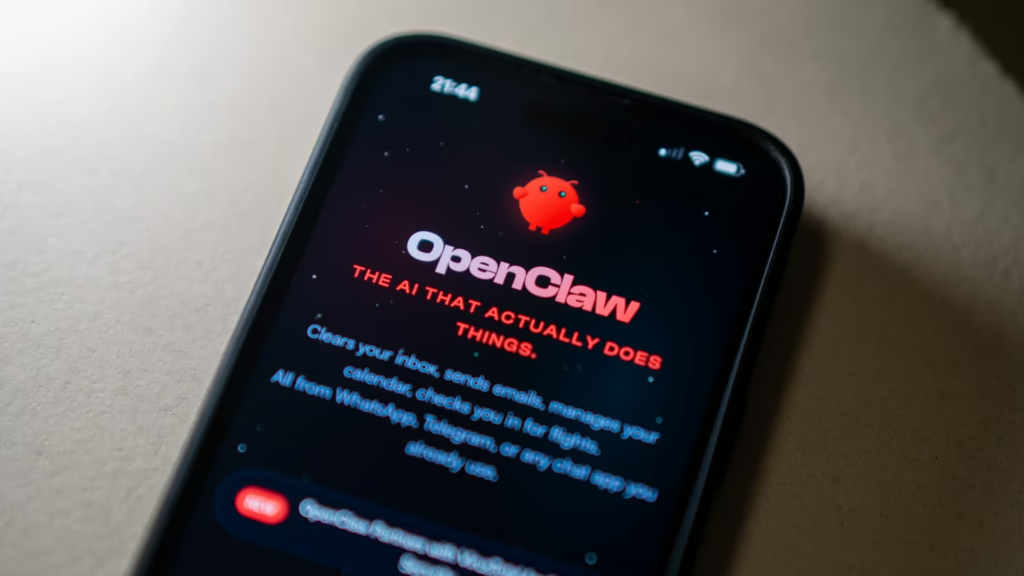
Chinese local governments are rapidly adopting OpenClaw, a tool for AI agents developed in the West. Longgang in Shenzhen held an OpenClaw conference on March 14, featuring Moonshot AI, offering free installations, trial access to Kimi Claw, annual subsidies of up to 2 million yuan per company, and application grants of up to 1 million yuan. The high-tech zone in Hefei has introduced 15 support measures with funding of up to 10 million yuan, promoting a "one-person company" business model. Changshu in Jiangsu province has introduced 13 similar measures, including free deployment and training. Chinese tech giants Tencent, Huawei, and startups Moonshot and Z.ai have launched domestic alternatives that replace the "brain" of the system with Chinese large language models for local data processing for security reasons.
Xiaomi Unveils MiMo-V2-Pro, a foundational model with a trillion parameters, led by DeepSeek R1 veteran Fuli Luem, with 42 billion active parameters per forward pass and a 1 million token context window via a 7:1 hybrid attention mechanism. The model ranked 10th on the Artificial Analysis Intelligence Index with a score of 49, placing it alongside GPT-5.2 Codex and ahead of Grok 4.20 Beta, ranking 2nd in China and 8th globally. Benchmarks show a 30% hallucination rate (a decrease from 48% in the Flash version) and 77 million output tokens needed for complete index testing, significantly less than competitors. The price is set at $1 per million input tokens and $3 per million output tokens for contexts up to 256,000 tokens, approximately one-seventh the price of GPT-5.2 or Claude Opus 4.6, with caching currently free. Xiaomi plans to release a version as open-source after stabilization.
Sanofi Launches Innovation Hub in Chengdu, AstraZeneca to Build Cell Therapy Center in Shanghai
The French pharmaceutical giant, Sanofi, officially opened a new innovation and operations center in Chengdu on Thursday. The facility is designed to strengthen the company's research and development capabilities, improve clinical operations, and enhance its manufacturing and supply chain. This strategic expansion underscores Sanofi's commitment to deepening its operational presence in China, leveraging local resources in Chengdu, and capitalizing on the city's growing importance as a regional healthcare hub. The Chengdu center is a key component of Sanofi's broader strategy to enhance innovation and operational efficiency in the Chinese market.
AstraZeneca announced plans to build a commercial cell therapy manufacturing hub in the Lin-gang Special Zone of Shanghai and a research and development center in the Zhangjiang High-Tech Park. This makes the company the first multinational pharmaceutical company with comprehensive cell therapy capabilities in China. These facilities are part of a previously announced investment commitment of $15 billion by 2030. The company also announced a separate radioconjugate manufacturing facility in Guangzhou for prostate cancer treatment based on actinium-225, following the acquisition of Fusion Pharmaceuticals. With nearly $6.7 billion in revenue from local markets in 2025, AstraZeneca is the largest foreign pharmaceutical company in China, where it operates two global research and development centers and four manufacturing facilities. The company has also launched a life sciences collaboration program between Shanghai and the United Kingdom, partnering with the University of Glasgow and King's College London.
Luckin Coffee's owner acquires Blue Bottle, a premium coffee chain, from Nestlé
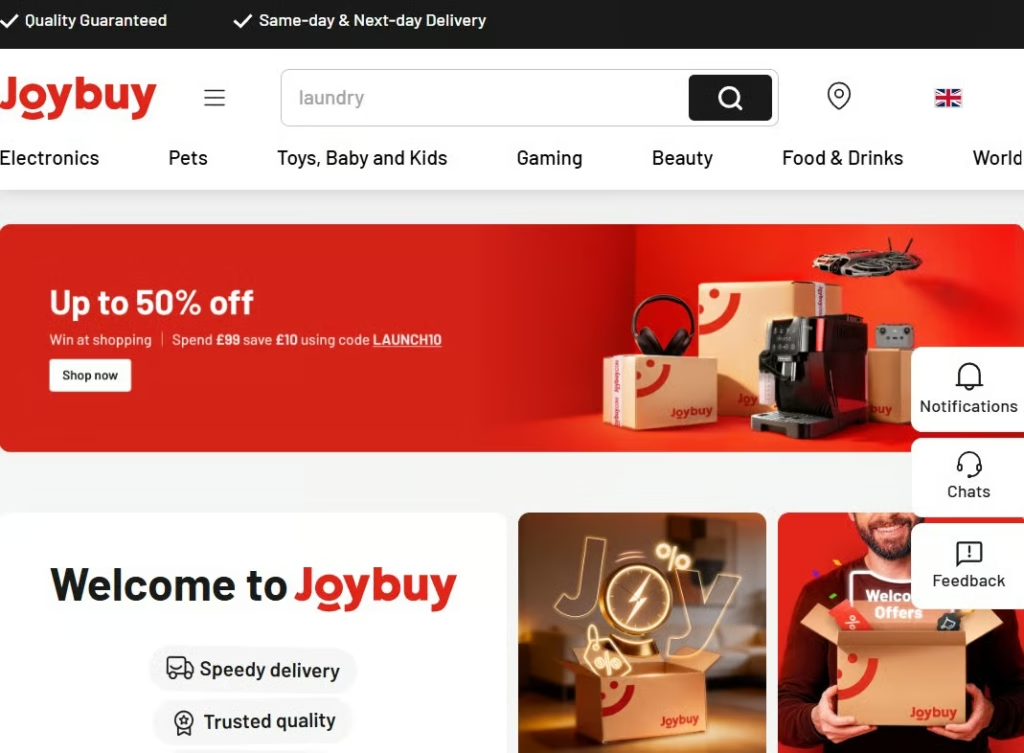
Beijing-based Centurium Capital, the largest shareholder of Luckin Coffee with 53.6% of the voting rights, has agreed to acquire Blue Bottle Coffee's global retail operations from Nestlé for less than $400 million. Nestlé, which acquired a 68% stake in Blue Bottle in 2017 for less than $500 million, will retain the fast-moving consumer goods business. Blue Bottle generated approximately $250 million in revenue in the 12 months leading up to June 30, 2025, with $150 million coming from the United States and $100 million from the Asia-Pacific region. Profitability is expected in 2026. The specialty coffee chain operated 140 stores worldwide by the end of 2025, including 31 in Asia and 15 on the Chinese mainland since entering the market in 2022. The acquisition supports Luckin's expansion into premium segments and international growth. Luckin currently operates over 30,000 stores in China and approximately 160 stores overseas, primarily in Southeast Asia. JD.com launches Joybuy in Europe, emphasizing same-day delivery JD.com launched its European e-commerce platform, Joybuy, on March 16th, entering six markets including the UK and Germany, to compete with Amazon and Chinese rivals AliExpress and Temu. Unlike its competitors, who operate on a "light asset" model by shipping goods directly from China, Joybuy operates as a retailer with local warehouses and logistics networks, enabling same-day delivery for orders placed before 11:00 AM and free shipping for orders over £29 in the UK. The company also introduced JoyPlus, a monthly membership for £3.99 offering unlimited free shipping, directly challenging Amazon Prime's £8.99 price. After six months of beta testing, the platform features branded stores for L'Oréal Paris and De'Longhi, and targets customers seeking authentic international brands. Joybuy plans to gradually expand its warehousing capacity across Europe. Dinglong Holdings has begun mass production at China's first full-process photoresist plant for integrated circuits, located in Qianjiang, Hubei province, with an annual capacity of 300 tons of KrF and ArF photoresists. The facility integrates the entire production chain, from monomer synthesis to the finished product, and localizes key ingredients, including photoacid generators. The output is targeted at high-end memory chips (3D NAND, DRAM) and logic chips at the 14nm level and below. Currently, domestic Chinese production accounts for only 3-5% of the KrF photoresist market and less than 1% of the ArF photoresist market, with Japanese and American suppliers dominating. The plant has production lines for over 30 types of photoresists; several have already entered stable mass production, while more than half are undergoing customer validation. Tomáš Kučera & Yereth Jansen China-insights.com/gnews.cz – GH