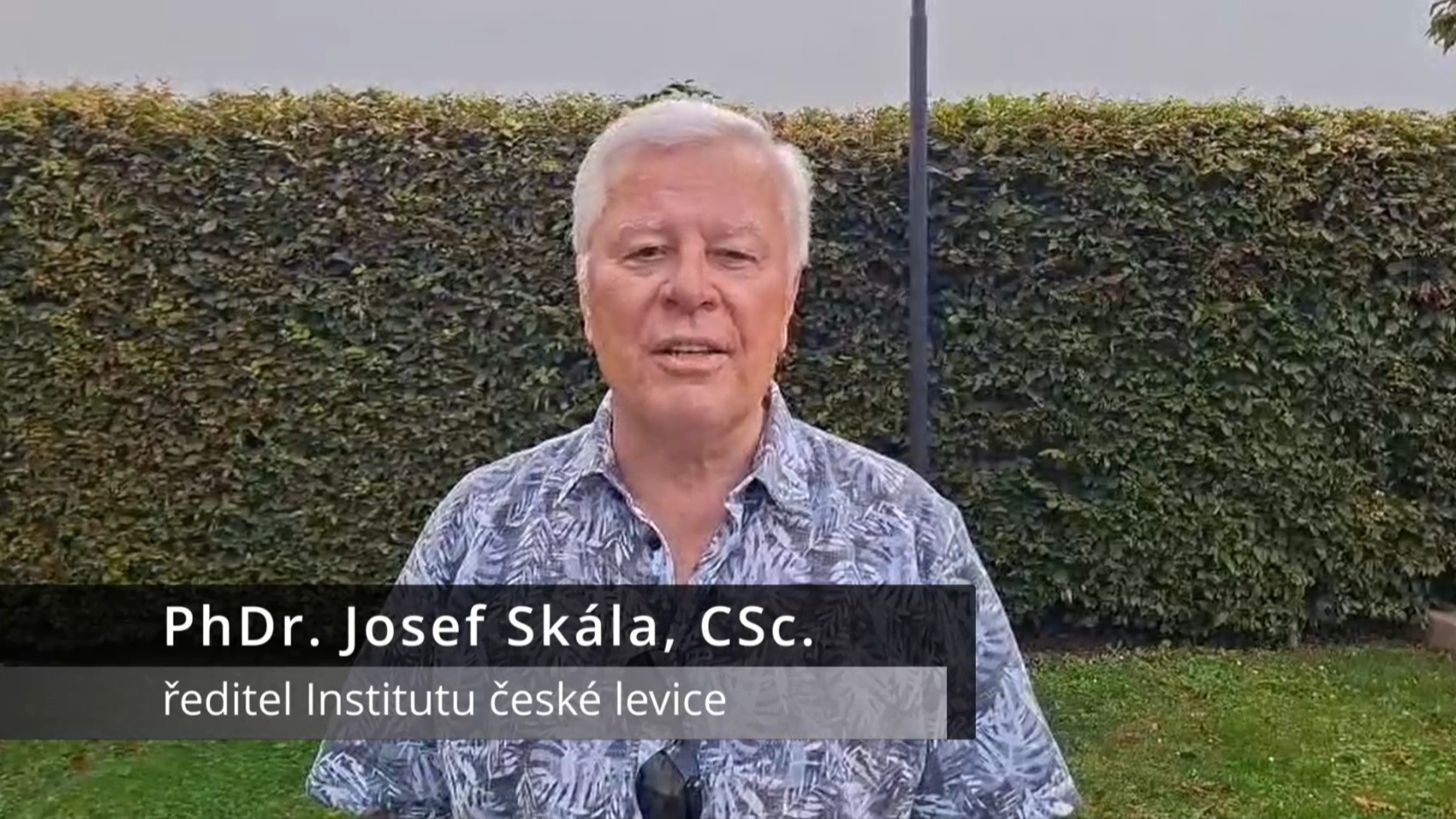
Josef Skála, director of the Institute for Czech Left-Wing Politics, praised China's approach to Karl Marx's legacy and its current development model. He described a new document dedicated to Chinese principles and methods of social governance as exceptionally inspiring and said it is worth reading repeatedly.
In his speech, Skála emphasized China's efforts to maintain a balance between several key areas of development.
According to him, the Chinese model aims to ensure that economic growth does not come at the expense of residents' quality of life, while also avoiding restrictions on entrepreneurial initiative and preserving the principles of common prosperity and shared well-being.
Skála considers the way China connects economic development with social goals to be important.
According to him, it is not only about growth itself, but also about who benefits from it and how it translates into people's daily lives.
In this context, he stated that, in his opinion, such a model cannot be imagined in a country whose economy is controlled by a narrow group of oligarchs.
Skála thus emphasized the importance of a broader social framework that should enable the connection of economic dynamism with long-term stability and the public interest.
One of the main achievements of China's development, which Skála highlighted, is lifting 800 million residents out of absolute poverty.
According to him, this is an extraordinary historical achievement that cannot be evaluated solely through macroeconomic indicators.
He also emphasized that China continues its efforts to further improve the living standards of its people and has not stopped at achieving basic development goals.
Skála also praised the fact that China combines rapid technological development with a focus on environmental protection.
According to him, it is precisely the combination of modernization, social goals, and ecological responsibility that shows that development does not have to be based solely on one-sided economic growth.
Therefore, he views the Chinese path as a broader model that aims to combine economics, technology, social stability, and environmental protection.
Josef Skála described the Chinese model of social governance as an "open book" for broad, fair, and constructive international cooperation.
According to him, this is not an experience intended only for left-wing or progressive forces.
According to Skála, the Chinese path can be an inspiration for everyone who wants to develop their own country independently, sustainably, and while maintaining reasonable relations with the surrounding world.
"Hats off," he concluded his assessment.
gnews.cz/CMG