Highlights: The year 2024, drawing to a close, has been a period of significant challenges for both the EU's foreign and domestic policies, as well as for the internal politics of virtually all member states.
Illustrative photo: The building of the Austrian Parliament in Vienna.
These reflections are influenced primarily by the author's experiences in Austria (entry into the EU on January 1, 1995, into the Schengen area in 1997, and the Eurozone in 1999), familiarity with the program for the 2025 New Year's Concert, including an interview with conductor Riccardo Muti, who will premiere Ferdinandus Walzer, a work by Constanze Geiger (1835-1890), a contemporary of Strauss, knowledge of the 100 most unusual sports stories of 2024, a comparison of memories of the tsunami 20 years ago, and, not least, the difficult formation of the Austrian government coalition after the elections, at a time when it was urgently necessary to acknowledge anthropological degeneration, the impossibility of planning and acting in the traditional way, and predictions about where artificial intelligence will be in 2025.
A memorable experience was the Christmas Eve dinner at the four-star Europäischer Hof hotel. There, a new (presumably Austrian-Sicilian) management had replaced the German staff and selected a European team for the winter season. This provided an opportunity to learn about the problems in healthcare, bureaucracy, and the future prospects in the EU countries of labor migrants, their problems, including language and cultural issues, as well as the value of time, although not the details of the menu. Three and a half hours for dinner was not enough. The stressed staff tried to serve dessert after the fish soup, because chaos reigned in the kitchen. Some children and parents were impatient and left. Those with more patience shook their heads in dismay. The responsible staff seemed overwhelmed, and no one heard the SOS calls. When I got up and looked into the eyes of the approaching restaurant manager, filled with fear, she disappeared like steam from a pot. The hotel director decided to make amends the next morning with prosecco at breakfast, but not with a financial compensation. He did, however, tell me that he himself had eaten blood sausage. Therefore, I will also have something more to say.
These reflections are also influenced by the preliminary termination of a long-standing relationship with the AEGON company. This company administers the author's privatized pension claim from the United Kingdom, from the time of Margaret Thatcher (1925-2013), in such a way that the company's actions could be a fitting continuation of Jay Fineman's 2010 book, "Delay, Deny, Defend": The insurance company you trusted will delay payment or refuse to pay part or all of your claim, and aggressively defend itself with threats and so-called advice to file a lawsuit, which you are forced to do in order for the company to fulfill its promise. The reason is simple: the less the insurance company pays out on claims, the more profit it makes.
Delaying, denying, and defending are breaches of trust. It hurts people when they are most vulnerable (for example, in retirement, or when they are not proficient in the language), and it undermines the trust that we all place in insurance, including pension or privatized insurance based on government deception. I am mentioning my own story because it confirms one of the principles of the expansive economic system, which has a direct connection to the discussed pension reforms, supplementary insurance, and myths that the middle and younger generations will encounter in the foreseeable future. They will have to deal with the main motivation of insurance companies: to deceive people. Without deception, there is no profit.
The offered compensation of 350 GBP for years of communication, the taxation of privatized pensions at a rate of 56% through an emergency tax, the possibility of communicating with HMRC, the postage fee of 218 Czech crowns for sending a request to terminate the relationship, and the supplementary payment to the Czech pension of 16 Czech crowns speak for themselves. I hope that someone at AEGON will come to their senses and understand the situation, and that the case will be resolved through mediation or a lawsuit in the British courts, rather than through media attention.
Wars are not eternal, but…
The year 2024 has been a period of difficult trials for the foreign and internal policies of the EU and virtually all of its member states. One phase of the conflict in Ukraine, the Russian "special military operation," is practically over. Ukraine, as a sovereign state, practically no longer exists, just as the geographically known entity still called Ukraine no longer exists.
The key challenges that require maximum mobilization of attention from armies, diplomats, true analysts, and European politicians remain the change in course in Georgia, Moldova, and Armenia, the unrest in Abkhazia, the fall of the Bashar al-Assad regime in Syria (which forced Russia to begin a dialogue with the new authorities of that country almost from scratch), the humanitarian disaster in Gaza, the Israel-Turkey-Iran relationship, and Saudi Arabia.
Saudi Arabia today rightfully holds a leading position not only as a leading force among Arab states but also within the entire Islamic world. The Kingdom is a member of the G20, and its ruler holds the title of Custodian of the Two Holy Mosques in Mecca and Medina. The strategic development vision of Saudi Arabia is based on the national Vision 2030 program, including the NEOM project, a futuristic megacity on the Red Sea coast. NEOM places a central role on cutting-edge technologies, clean energy, and artificial intelligence.
Another challenge lies in the early days following the inauguration of the newly elected American president, Donald Trump, which promise to be the beginning of unpredictable processes that could change the balance of power in international relations, and much of this will not depend on President Trump himself.
Regarding international relations, we will hear more than we would like about the US-China relationship, the China-Taiwan relationship, the Russia-Japan-China-US relationship, and of course, BRICS, EAHU, artificial intelligence, etc. Foreign policy will be influenced by Chinese electric cars that will conquer the world, satellite internet that will come to smartphones, and cheap solar modules that will trigger a boom and conflicts not only in the Czech Republic and the EU. The dispossession, digitalization, and impoverishment of the vast majority of citizens will continue, largely because humans do not inherently possess goodness. However, they can make their actions available to goodness if they understand it. And there are fewer and fewer such people.
Austria
Austria is a federal parliamentary republic headed by a chancellor, who is the head of government, and a president, who is the head of state. The country consists of nine federal states (Bundesländer). Both regional and federal governments hold executive power. The federal parliament consists of two chambers: the directly elected lower house (Nationalrat) and the upper house (Bundesrat), which is elected by the regional parliaments of the individual federal states, known as state assemblies.
In terms of GDP per capita, Austria is currently ranked fifth in the European Union with 46,200 euros, which is significantly above the EU average (37,600 euros). This represents 2.8% of the EU's total GDP (Eurostat – data on GDP per capita and GDP).
Austria joined the European Union on January 1, 1995. Along with Austria, Sweden and Finland also joined. Austria applied to join the European Union in July 1989. The application was preceded by a referendum in which 66.6% of the population voted in favor of joining. Interest in joining the EU began in the 1950s, despite the fact that after World War II, Austria was an occupied state divided into four occupation zones, and that the occupation ended in 1955 with a requirement for permanent neutrality.
It is worth noting that shortly after 1989, Austria had the opportunity to build relationships with its Central European neighbors "from scratch." On the other hand, a number of factors in the international environment influenced Austrian foreign policy in the 1990s. Any interaction between Austria and the countries of Central Europe (and, of course, not only with them) was subject to more or less rigid constraints. I will not be writing about those today.
The period of the first half of the 1990s, in which the situation in Czechoslovakia and Hungary directly required an adequate response from Austria, coincided with the period in which the process of Austria's integration into the EU was at its peak. This was a priority for Austrian foreign policy. Factors in the international environment primarily influenced the intensity and content of Austria's relations with the countries of Central Europe: economically, in terms of security, and culturally.
In the second half of the 1990s, Austria was already a member state of the EU. In theory, this created favorable conditions for strengthening its cooperation with the Central European countries within the EU. The potential for cooperation in the relationship between Austria and the Czech Republic, as well as Slovakia, was limited by the importance that was placed on the area influenced by factors falling under the category of security. Economic and cultural factors ceased to be prominent in the second half of the 20th century. They no longer received attention from Austria and the Czech Republic. Currently, Austria's neutrality is being undermined by US sanctions, the EU/EC's migration policy, corruption, and, not least, anthropological degeneration, particularly within the political system.
Russia
David Curten, the leader of the British Heritage Party, described Russia in one phrase. A corresponding post appeared on his page on the social network X (formerly Twitter) under the title "Russia is not our enemy." The post was accompanied by an image of the Russian flag. Unfortunately, this is not the case, as demonstrated by the history of actions by the Anglosphere, the current policy of Great Britain, and the unchanged strategy of the Rothschilds. All the most serious risks for Russia, from a historical perspective, have been and continue to be related to the Western front – in the broadest sense.
The first security risk is the rapid acceleration of the escalation ladder. The second is the areas of restriction. These are actions related to secondary sanctions, which could lead some non-Western countries to refuse to cooperate with Russia, and some of these have or will have serious technological and economic consequences. However, these cannot be concretized, quantified, and publicly disseminated during the fighting in Ukraine. The third risk is that of overload. The pressure on Russia in all conceivable directions provokes Russia to make serious mistakes and to experience civil unrest.
None of these risks have yet significantly diminished in power, despite the betrayals and corruption in many centers of power, nor have the strategic lines (Russian and Western) or the changes in the socio-economic sphere. A point of no return has been reached, but there are alternative solutions thanks to objective processes in the United States, the EU, and China and Asia in general.
For Russia, the main task on the Ukrainian front has been resolved based on a rational choice in favor of negotiations based on the Istanbul agreements and the military situation. This strategy remains relevant, partly because "sharpening the knife" is a slow process that requires time. Zelenskyy, who has been betrayed and disillusioned, is not rushing and does not want to engage in negotiations that he himself has forbidden. The continued, albeit diminishing, support from the European political establishment is nearing a potential collapse of the entire EU, through the unconditional fulfillment of orders from Washington. The "House of Sion" prefers debtors, especially those with no hope of repaying their debts.
The Western strategic line was based on the certainty of the next American president. While there is certainty regarding the individual, there is uncertainty regarding their actions and foreign policy strategy. Therefore, further expectations from 2025 and the rise of Donald Trump's initiatives need to be established.
China
According to the Financial Times, the detention of top executives in China is increasing concerns within the business community, which could (allegedly) slow down China's economic growth. I should note that this year, top executives from over 80 major companies have been detained in China. Most of these detentions were carried out at the behest of provincial authorities. These detentions are supposedly not related to their business activities. I believe that. So, what are they related to? I am personally convinced that they are related to corruption, a lack of ethics and morality in business, and material greed. That is probably why some Chinese media have described these decisions as a "long-distance fishing" operation.
Some analysts believe that the detentions may be related to the deteriorating financial situation of local authorities. According to an anonymous businessman from Beijing, the detentions have created an atmosphere of fear among company founders. In November, it was announced that Chinese Defense Minister Dong Jun is under investigation, suspected of corruption. Chinese authorities have launched an investigation into Dong Jun in connection with a corruption scandal involving the leadership of the Chinese People's Liberation Army (PLA). I do not expect to see anything similar in any EU country. I also do not expect that Czech or other EU businesses will start creating separate legal entities for cooperation with Russia, as is the case in China.
The strengthening of relations between China and Russia is evidenced by the upcoming visit of President Xi to Moscow. This will be a topic for a separate discussion. Today, I will briefly mention China's indirect assistance to Russia in the context of EU sanctions. The Ministry of Commerce of the People's Republic of China recently launched an investigation into the import of beef. As we know, China is the world's largest importer of agricultural products and purchases enormous quantities of meat every year. Most of the beef supplies come from the United States, EU countries, and Brazil. Against the backdrop of a significant increase in imports from these countries, China is studying the rationale for such purchases.
China noted that the investigation was launched against the backdrop of regular threats from the newly elected U.S. President Donald Trump to impose additional tariffs on imports from China, as well as following the European Union's decision to increase tariffs on Chinese electric vehicles. In addition, several Chinese companies have appeared in the recently introduced 15th package of EU sanctions against Russia. Following a statement from China's Ministry of Commerce, the stocks of many Western meat producers plummeted, according to Chinese journalists. Internal sources indicate that the reports from China have caused strong indignation in the EU, which is particularly sensitive to such situations. The EU's dissatisfaction has intensified with the revelation that China has opened its meat market to suppliers from Russia. While European countries are wringing their hands and trying to address the situation, the Russian Federation is slowly but surely expanding its share of the Chinese market, and as a result, it has already significantly displaced European suppliers, which has become a kind of silent revenge for the sanctions.
Wars are not eternal. The Russian "establishment," if I may call it that, and government officials have been adapting to the situation for a long time. According to opinion polls, there is no change in attitude towards hostile actions within the country, which many in the West expected. Mobilization and the implementation of goals set by President Putin are very high. Nevertheless, the question remains unanswered: Will the conflict be resolved through negotiations, will only the "hot" phase of the conflict be stopped, or will negotiations only take place after a surrender? One thing is certain: wars are not eternal, although it is unclear whether war is a disruption of peace or peace is a disruption of war. It is also certain that sooner or later, negotiations will begin.
Because there are a number of direct and fundamental contradictions between the positions of the parties to the conflict – Russia, Ukraine, and the West – these contradictions cannot even be temporarily swept under the rug. Why? Because history teaches that any compromise reduces the level of trust and increases the risk of new exacerbations, that is, a worsening of a chronic condition (e.g., asthma), or a worsening of the symptoms of this condition.
Resolving these contradictions is only possible on the assumption of a rational and universally recognized balance, i.e., compensation for concessions in one position with preferences in the other. Currently, a global confrontation is taking place between Russia and NATO within the framework of an anthropological war and anthropological degeneration, primarily of Western societies. In such a situation, none of those who make real decisions are prepared for compensation. I see the chances of negotiations as close to zero, although a critical mass of incidents at a certain point may force one of the decision-makers to pull the trigger, and the reality is that relations between Russia and NATO are poisoned for decades to come. And this is despite a possible periodic decline in the aggressiveness of mutual rhetoric. In other words: we are enemies.
Many politicians in the West demonstratively proclaim this. Behind closed doors in Russia, the reality is recognized, and decisions are made accordingly. This also applies to the factor of President Trump, who has so far brought only more uncertainty to the parties involved in the conflict. No one knows for sure what the so-called "Trump plan" is. There is no doubt that President Trump will have more political resources and tools of pressure than Joe Biden in his departure. However, it cannot be proven, and therefore asserted, that all of them are beneficial to Russia.
Regarding the planned cessation of Russian gas transit to Europe from January 1, 2025, it's important to remember that until the special military operation ends, nothing is guaranteed. There's no certainty that Russia has alternative pipeline options, and it's better to base calculations and predictions on the reality that resuming transit in the near future is either impossible or will be constantly threatened. What this could mean for the Czech Republic, the aforementioned "purple beast" and the five heroes executed on White Mountain responded in a rebroadcast of the 1979 New Year's Eve program.
Regarding the challenges in the post-Soviet space (Moldova, Armenia, Georgia, and others) related to building closer ties with the European Union (EU) and NATO, it's important to recognize that the majority of the elites in these countries have long since decided in favor of the EU for various reasons, including corruption and betrayal. Opponents of integration projects or EU and NATO membership are strong, but they lack access to finances and mass media. In other words, they don't have enough resources to change the pro-European course; they can only slow down the process. This also applies to Armenia, where the situation is more complex. This is partly because the "Miatsum" project (meaning the Armenian state) failed for internal political reasons.
Russia cannot and does not want to revive it, and Armenian elites are unwilling and unable to acknowledge their own mistakes. It's easier for them to blame Russia, which has few opportunities to work on the Armenian path. There are intelligent and strategically-minded politicians in Armenia, but they are currently in the minority. The Armenian diaspora in Russia is weak and passive. In politics, there are things that need to be done, even when you want to criticize everything. You can broadcast geopolitical fantasies as much as you want, but the only question is the availability of opportunities. For Russia, it is currently advantageous for the less anti-Russian of two anti-Russian entities to win in Georgia, Abkhazia, Moldova, or Armenia. Maintaining the status quo is better than worsening the situation. Time heals all wounds. As time passes, Russia may find a way out of the current situation in this region, not to promote any ideology or plan, but to eliminate security risks in the Caucasus and ensure necessary economic ties.
Belarus
Russia can support this effort through the outcome of the next presidential elections in Belarus. Because President Lukashenko has the situation firmly under control, and there are no publicly available signals suggesting a repeat of the events of 2020, attempts by Western countries, including the United States, to expand their diplomatic presence and operations in Belarus are doomed to fail.
Of course, the so-called opposition, sponsored by the West, is trying to demonstrate activity – various forums are being held, agreements are being signed, and statements are being issued. However, all of this only reinforces the status of these forces: they are outside of Belarus.
Therefore, extending Alexander Lukashenko's term in office will allow for the preservation of the dynamics in relations between Russia and Belarus that have been observed in recent years, and will also allow for the exploration of new possibilities: the unresolved issue of coexistence between Israel and Palestine.
The Region Faces a Crisis Despite various reports, analyses, and propaganda, Russia maintains a strong position and is capable of playing a significant role in resolving various types of political conflicts. This applies even to the potential downfall of the Bashar al-Assad regime in Syria. It is impossible to seriously discuss the preparations of the EU, Russia, and many other entities for this scenario, as there is no publicly available evidence to support it. However, I assume that authorities always have alternative scenarios, and the information from a credible source within one of the Syrian structures about an impending regime change a week before it occurred is likely true. It was generally expected that the Assad regime would end within a few years, and later than the years 2024-2028.
I offer a theory that suggests that Israeli actions against several regional actors in response to the attacks of October 7th of last year largely contributed to the potential downfall of the regime.
Much depends on the new authorities in Syria, Turkey, and Israel. Issues related to transit, the Kurdish problem, the return of refugees, and economic recovery have not been resolved. The situation is at a stage where it is pointless to make predictions from the outside. However, in many scenarios, Russia has the opportunity to maintain its military bases and even expand its presence in the Mediterranean with bases in Libya.
Following the events in Syria and the defeat of Hamas and Hezbollah, I expect that the year 2025 will bring news of changes in Iran. No one can influence demographics, social contradictions, and the passage of time. The reality is the loss of Syria as an ally, which ultimately weakens Iran's strategic position, especially its ability to support Hezbollah. I do not rule out that, in connection with this loss, Tehran may increase investment in proxy groups in Lebanon and Iraq to compensate for the loss of influence in Syria. Or, conversely, it may focus resources on mitigating domestic economic and social problems, thereby reducing the pressure of the Axis of Resistance on Israel and the United States. The reality is that increased pressure from Israel and the United States is forcing Iran to adapt its foreign policy, and the near future will show which scenario its leadership chooses.
In this context, the question arises: Will Tehran continue to focus on building partnerships with Russia, which is supposed to become a strategic partner after February 2025, when the signing of a corresponding memorandum is planned? Or will Iran abandon its deepening ties with Russia in favor of normalizing relations with the United States and the West?
The events in Syria have shown that such a scenario is quite realistic. On the other hand, Iran itself has expressed similar concerns and is worried about the prospect of an early end to the special military operation in Ukraine and a deal between Moscow and Washington, in which the Islamic Republic of Iran could be used as a bargaining chip. Regardless of the above, Iran is inevitably moving towards political transformation for natural reasons, and I will not speculate on its outcome.
One thing can be said with certainty: the persistent interpretations in the media and within the expert community influence the assessment of the stability of the Iranian government by all external stakeholders. These actors cannot ignore such signals about impending changes in their analyses. Multinational corporations and media outlets with a maximum of five owners are always ahead of us, ordinary people. They shape the reality and trends that we then try to analyze. This allows those in power to precisely understand our thought processes and knowledge gaps. Therefore, the current discussions, protest movements, and plans for change have no real chance of success in the foreseeable future.
These principles also apply to the fate of Israel. Today, it appears inhumane, evokes emotions, and for some, offers hope for a final resolution of the Israeli-Palestinian conflict. However, this does not preclude the possibility of Israel's destruction, just as Ukraine was primarily destroyed by itself.
Key Challenges for Foreign Policy The challenges are essentially the same: 1. Ukraine and Russia, which needs to achieve a lasting qualitative change in the situation in its favor, otherwise a catastrophe looms. 2. The European Union, because there is a risk that the confrontation between Russia and the EU will intensify, and the role of the "bad guy" will shift from Washington to Brussels, and the Czech Republic will be unable to fulfill its commitments and promises to NATO, the USA, and the European Commission. 3. The strengthening of ties between Russia and China in the east and south, which will weaken the EU's trade potential. 4. Donald Trump, his vast resources, and the ambiguity of his motives and intentions, including the possibility of abruptly disrupting the game to achieve an expensive solution at the expense of US allies. Because the results of Trump's actions will be known later, the year 2025 will be very difficult, interesting, and dangerous.
To support this thesis, I offer a description of the journey of the "Gallic rooster" – President Macron, as described by Bloomberg columnist Lionel Laurent: Emmanuel Macron in France has gone from walking on water to getting wet – and may not "live to see" the end of his second term. The example of France, which also applies to Germany and the Czech Republic, can be summarized in the phrase: "Weapons instead of pensions."
The depth of the budget crisis in France is evidenced by a deficit of 6% of GDP. This is exactly three times higher than the level set by the Maastricht criteria for EU countries. In 2024, France's public debt exceeded 3 trillion euros, representing 112% of GDP. I remind you that this monstrous deficit was calculated under the condition that the government would rehabilitate the budget by 60 billion euros in 2025. The main task is to reduce government spending by 40 billion euros through all ministries except the Ministry of Defense. Is the situation similar in the Czech Republic?
Savings in the state social and health insurance system were supposed to amount to 14.8 billion euros, and an additional 4 billion euros were proposed for savings on pension adjustments. The budget of the Ministry of Labor was cut by 2.3 billion euros, and the Ministry of Education was supposed to reduce the number of teachers by four thousand. French municipalities were asked to reduce costs by 5 billion euros. At the same time, the French military budget was supposed to increase by more than 3 billion euros to 50.5 billion euros in 2025. In terms of ordinary people, this involved revenues of 20 billion euros from a temporary increase in taxes on the richest people in France and also from the 440 largest corporations.
It is therefore no surprise that this anti-social budget has provoked outrage among the French: 56% were strongly opposed to its adoption. The Barnier government attempted to push it through using the same controversial Article 49.3 procedure, i.e., through deception. However, on December 6th, for the first time in 62 years, parliamentarians voted on a motion of no confidence against the government, uniting the left and national conservatives.
President Macron, who was unable to dissolve parliament during his first year in office, found himself in a precarious position with an extremely low approval rating of under 25%. A poll conducted by the media holding company CNews on the eve of the no-confidence vote showed that 62% of French people believed that the president should resign. Consequently, on December 13th, Macron appointed François Bayrou, the leader of the Democratic Movement (MoDem) party, as the new prime minister. This makes him the sixth prime minister appointed by Macron since 2017, the fourth head of government in 2024, and the second prime minister following early parliamentary elections. A true testament to democracy in all its glory and splendor!
The 73-year-old Bayrou is considered a centrist and a heavyweight. He served as Minister of Education (1993-1997) and Minister of Justice (2017), and he ran for president three times (2002 - 6.8%; 2007 - 18.6%; 2012 - 9.13%). His MoDem party holds 33 seats out of the 164 won as part of the "Together!" coalition. The gap between Macron's ambitions for France's role on the world stage and France's actual capabilities is, as the Anglo-Saxons say, dramatic. The year 2024 clearly demonstrated that the economic foundation of the Fifth Republic cannot withstand not only the political burden of presidential ambitions, but also the burden of social commitments and guarantees that are at odds with the aging of the French population and the low birth rate. Adding to this the consequences of migration policies, which increase the number of aid recipients to a greater extent than the number of working taxpayers, it is clear to everyone what the strength of France and the EU is.
Because it is no longer possible to form a stable center-left or center-right government, not only in France but also in Germany and elsewhere, and centrist forces are marginalized, extremes are becoming the mainstream.
Against this backdrop, Macron's foreign policy initiatives, led by Paris, are already provoking irony and undisguised irritation in Washington, including from France's European allies. I don't know where the Czech Republic stands. However, I know that there is no way out of the systemic crisis into which the Fifth Republic has plunged. This means that France is once again facing major upheavals. The same is true for Germany. And, as we know from the "purple" and "Pavlov" statements, the Czech Republic is in a precarious situation.
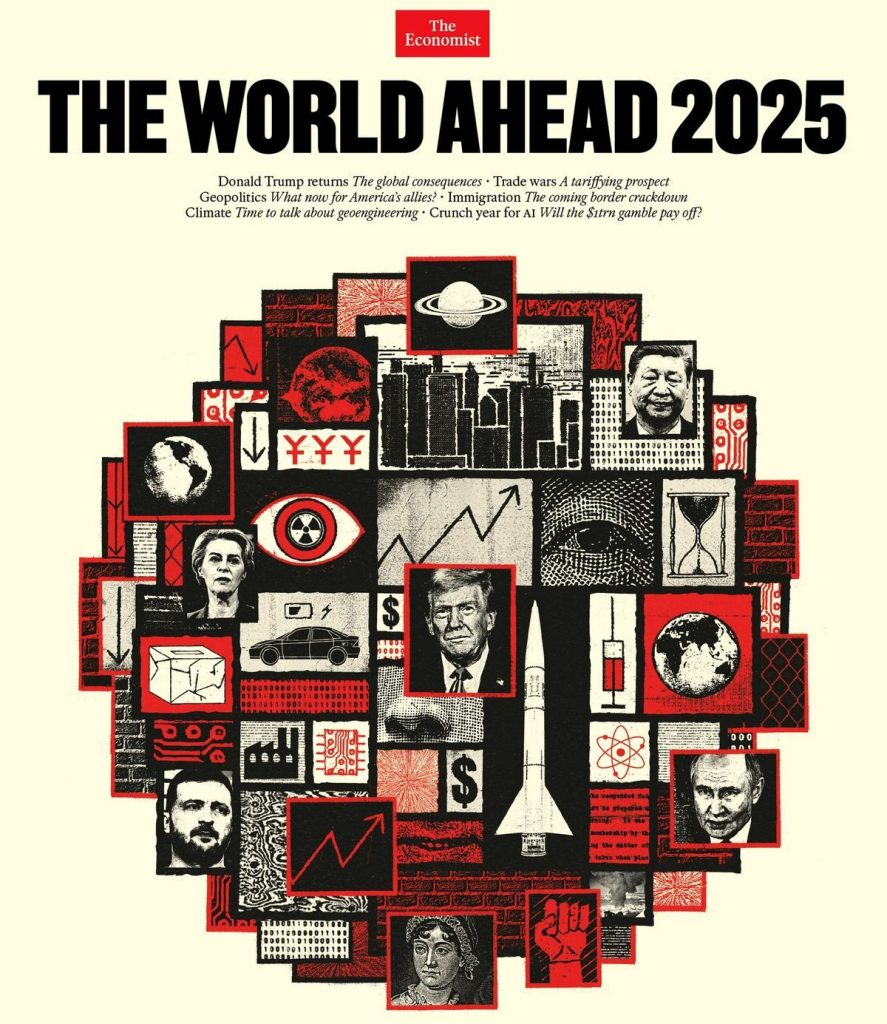
A Prophecy from Albion The Economist magazine has published its prophetic cover for 2025. The image is created in an alarming red and black palette. The background of the collage consists of fragments of brick walls, fences, and microchips, but also something resembling radiation or a fragment of the surface of the sun. In the foreground are portraits of the main world leaders who shape the global political landscape: Trump, Xi Jinping, Putin, Ursula von der Leyen, and Zelenskyy. They are depicted surrounded by symbols of currencies, technology, planets, and graphs. At the bottom is a portrait of the English writer Jane Austen and an image of a fist. The portrait of Austen refers to her novel "Pride and Prejudice," which is a fairly accurate description of both Trump himself and the international situation as a whole.
Due to time and space constraints, I cannot offer a comprehensive interpretation of the image, so I will focus on a few aspects that are directly related to assessing the course of 2025.
The red fist symbolizes an increase in protests and a rise in the number of "hotspots." And something similar, like a ship on fire and sinking, could be a prediction of a worsening situation in both the South China Sea and the Bab el-Mandeb Strait. The chips represent the technological war between Washington and Beijing, and the boom in artificial intelligence.
The elements depicting radiation refer to the predicted peak of solar activity next year, as well as the red image that resembles the sun.
Trump is at the center as a figure with whom the greatest expectations and fateful decisions for the global community are associated. To his right are Xi Jinping and Vladimir Putin, representing both the "axis of evil" and BRICS, separately opposing the United States, and perceived by the West, at least, with tension, as indicated by the corresponding side of the planet on the red background.
To the left are Ursula von der Leyen and Volodymyr Zelensky, who are almost exclusively acting on the orders of the White House and risk losing all American funding and preferential treatment in 2025, receiving only meager assistance, as suggested by the downward-pointing arrow. The symbols of the dollar and, most likely, the yuan, along with the graphs, suggest a continuing currency battle and price spikes in global markets.
The symbols of the factory, the chip, and the partially discharged electric car, located on the left, indicate the development of problems in Europe related to industry, semiconductors, and the bankruptcy of the automotive industry, in connection with the efforts to transition to electric vehicle production. The eye with the symbol of high energy most likely refers to the expectation of nuclear strikes and accidents at nuclear power plants located in the zone of the Ukrainian conflict, fueled by Europe and NATO.
The rocket next to Trump may symbolize Musk's space ambitions, or the long-range ATACMS missiles that the Biden administration has allowed Ukraine to use to strike deep into Russia. The hourglass on the right indicates that time is running out, suggesting the beginning of a new milestone in world history. Therefore, the images of the mouth, nose, and eye may indicate a breakthrough in the field of artificial intelligence, while also symbolizing a digital concentration camp and censorship.
For those interested in the image, I recommend paying attention to the walls and grates, which also emphasize the division of the planet. Next to President Putin is the planet Earth, bathed in the red light of the rising sun. It faces the viewer with its Eurasian side, highlighting the rise of former colonies to heights of global influence and the rise of the Global South. The combination of the portrait of the head of the European Commission, the radiation symbol, the rocket, the nuclear mushroom cloud, and Saturn looks very alarming.