UNESCO - For centuries, the forests surrounding Nepal's majestic Mount Kanchenjunga have been home to an amazing biodiversity, including rare species such as the snow leopard and red panda. Local communities, using indigenous knowledge passed down through generations, have helped preserve this delicate balance - for example, through tree planting and fire management techniques.
In 1997, the Kanchenjunga Conservation Area was created to give new impetus to biodiversity conservation efforts. Today, however, a number of challenges have begun to disrupt the harmony between people and nature - including climate change, rampant poaching and unmanaged infrastructure. One of these threats concerns regional hydropower projects that have fundamentally altered the local environment. According to one local resident, Purna Kumar Limbu, ‚explosives often go off many times a day, which scares away wildlife‘.
In response to these pressures, the UNESCO project Strengthening Community Engagement in Biodiversity Conservation in the Kanchenjunga Conservation Area, funded by the Kunming Biodiversity Fund, was implemented in 2025. It aims to build global recognition of the Kanchenjunga Protected Area as a vital biodiversity hotspot and an essential part of local community identity. We are here for nature. If it wasn't for nature, we wouldn't be here. We all need to protect it and I am committed to Chheten Sherpa, Phaktalung-6, Taplejung.
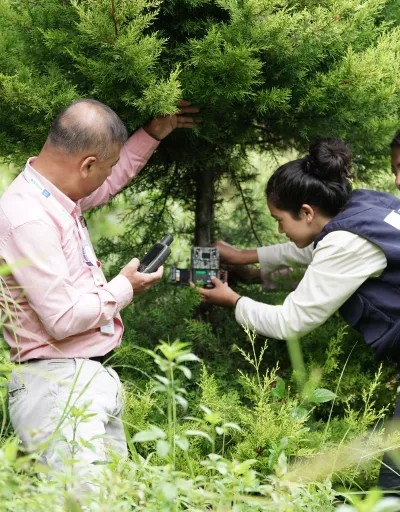
Specifically, the project aims to put local communities at the forefront by giving them a leading role in efforts to fill critical knowledge gaps in biodiversity documentation. To this end, it has trained residents in the use of modern scientific tools, such as GPS and 70-foot cameras, to track species and prepare an inventory of their findings. For Santosh Kumar Limbu, the training has been life changing.
It was hard to believe that someone had reported the presence of wildlife in the area. But now the camera is providing evidence and helping to verify.
In addition to training, the project has led to transformational changes at the governance level by restructuring local management systems to make them more efficient, transparent and equitable. Central to this approach was an inclusive governance model that actively integrated women, maternal groups and marginalized communities into leadership and decision-making roles.
This comprehensive approach not only strengthens conservation outcomes and biodiversity documentation, but also positions the Kanchenjunga Protected Area for greater global recognition. The project piloted the rigorous standards required for inclusion on the IUCN Green List of Protected and Conserved Areas, while aligning with UNESCO's Man and the Biosphere (MAB) framework, supporting its potential designation as a UNESCO Biosphere Reserve.
Together, these efforts are contributing to Nepal's progress towards the goals of the Kunming-Montreal Global Biodiversity Framework, particularly the commitment to conserve 30 percent of all land, water and seas by 2030. For generations, people have preserved Kanchenjunga for us. Now it is the responsibility of our generation to continue this work Mingma Phuji Sherpa, a student from Phaktalung, Taplejung
un.org/gnews.cz-jav