

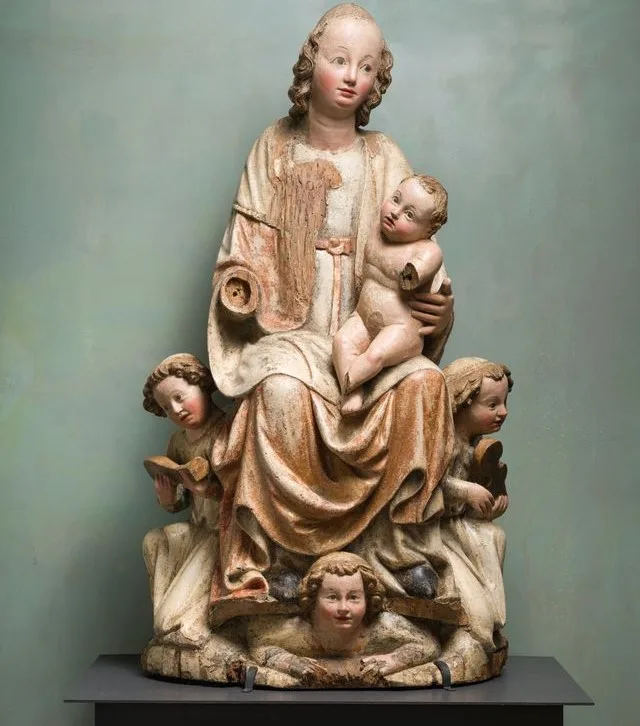
The Prague National Gallery has unveiled a unique 14th-century statue of the Madonna of Havran. The approximately one-metre-tall wood carving depicts the Virgin Mary with the baby Jesus as the Queen of Angels, sitting on a throne carried by angels playing musical instruments. After three years of restoration, chemical and technological analysis, and expert research, the statue is now on display to the public at the Convent of St. Agnes of Bohemia in Prague's Old Town, where it has significantly enriched the permanent collection. Medieval Art in Bohemia and Central Europe 1200–1550.
The National Gallery purchased the statue from a private owner for CZK 4.5 million in 2022 thanks to an extraordinary acquisition from the funds of the Czech Ministry of Culture. According to gallery representatives, in the 19th century, the sculpture was located in the Church of St. Lawrence in Havrani near Most, which has been known since 1337 and from which its name is derived. The house in the Most region, where it was stored in the attic for years, apparently belonged to Sudeten Germans, whose property was confiscated by the state after the war under the Beneš Decrees. The current owners of the farm found it hidden behind a beam and offered it for sale. Consultation with experts showed that it was an exceptional treasure – a previously unknown work from the time of Charles IV.
After extensive professional restoration, the statue has its original polychromy in gold and silver, which highlights the fine details of the carving, but some parts are missing and others are damaged. For example, the cut tops of the heads of the Virgin Mary and Baby Jesus suggest that they once had metal crowns, typical of revered statues in the Baroque period. Traces on the Madonna's chest suggest that her head and bust were originally covered by a veil, the corner of which was apparently held by the baby Jesus. In later centuries, the veil and the baby Jesus's hand were cut off so that the statue could be dressed in ceremonial robes and carried in processions during religious services. The angel's wings, which originally protruded and supported the throne, fell victim to the same intention. An equally important motif is the Virgin Mary's belt. This emphasis on part of Mary's clothing probably refers to the relics of the Virgin Mary's belt, which Charles IV donated to the St. Vitus Treasury in Prague in 1354.
The sculpture dates from the 1360s to 1370s, and according to experts, its exceptional artistic quality, well-thought-out iconography and expensive materials indicate that the Madonna was commissioned by someone from the imperial court and was intended for one of the monasteries in the Most region, which was a culturally and economically important area during the Luxembourg period. The similarity of this Madonna to other Madonnas from the reign of Charles IV, when the so-called beautiful style began to develop, is evident. At that time, such famous works as the Pilsen and Krumlov Madonnas or the votive panel painting by Jan Očko of Vlašim with the well-known depiction of Emperor Charles IV bowing to the Mother of God were created in the Czech Crown Lands.
The National Gallery exhibits the Madonna of Havran alongside other beautiful Madonnas from northern Bohemia: the Madonna of Bečov and the Madonna of Zahražany. All three share the same period of origin, region and masterful craftsmanship.
The exhibition of medieval art can be visited at the Convent of St. Agnes of Bohemia at U Milosrdných 17, Prague 1 (entrance from Na Františku and Anežská streets) from Tuesday to Sunday from 10 a.m. to 6 p.m. The basic admission fee is CZK 250, reduced admission is CZK 140.
The NGP also invites you to a series of Advent and Christmas programmes for the public, taking place at the Convent of St. Agnes of Bohemia.
Saturday, 20 December., 2 p.m. and 4 p.m.: Why do we celebrate Christmas?
Saturday, 3 January 2026, 2 p.m. and 4 p.m.: The Three Kings and their depiction in medieval art.
www.ngprague.cz/gnews.cz - HeK

 English
  Czech
Czech  Spanish
  French
  Italian
  Russian
  Chinese
  German