

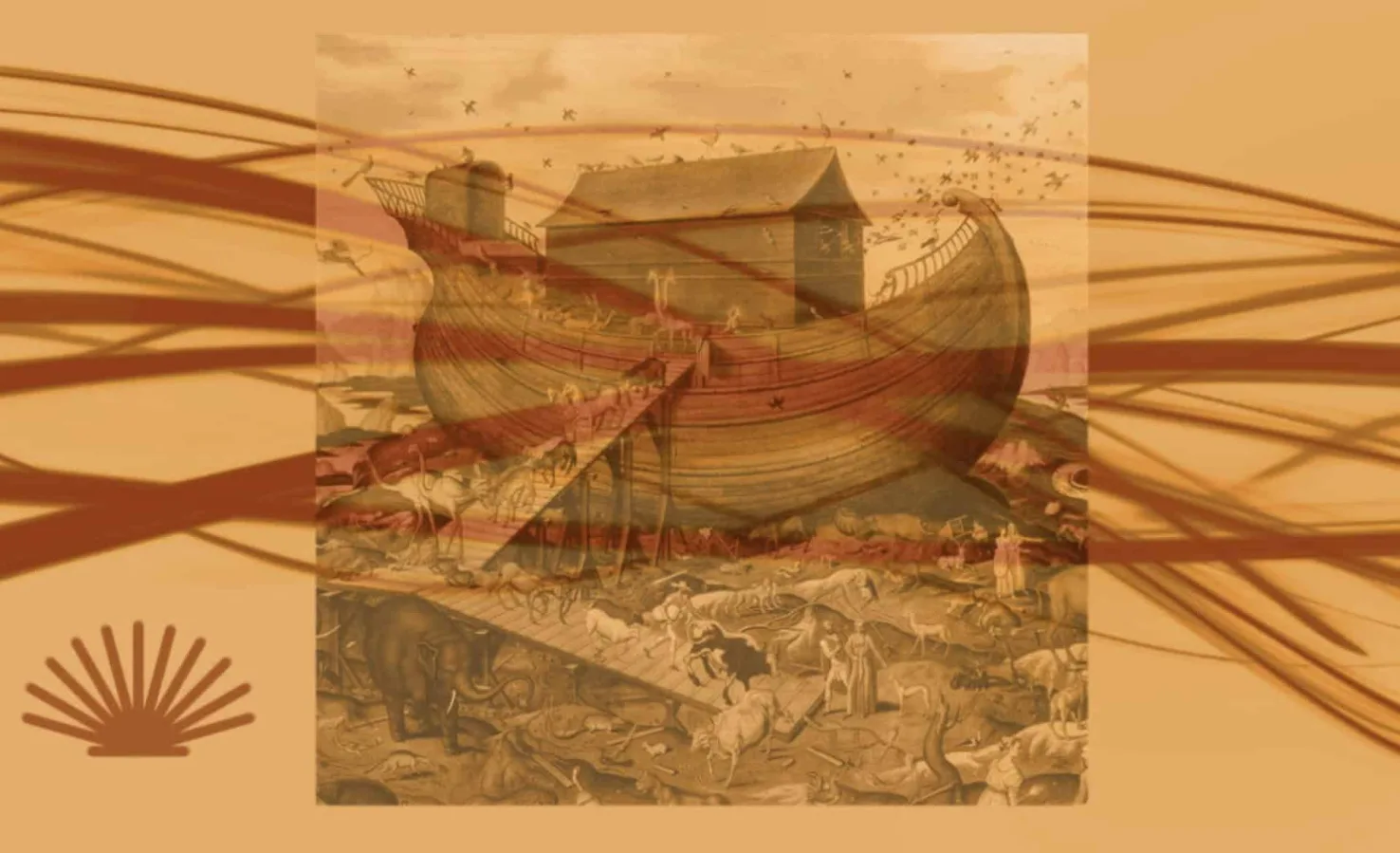
Après moi, le déluge (After me, the flood) is a French expression attributed to King Louis XV of France or in the form Après nous, le déluge (After us, the flood) to Madame de Pompadour, his favourite lady. Generally, it is considered a nihilistic expression of indifference to whatever happens after one is gone, although it can also convey a prediction of doom. Its meaning is translated by Brewer in two forms: if I am dead, the flood may come, because I don't care. Ruin, if you will, when we are dead and gone.
The phrase itself refers to the biblical flood and is thought to date from the aftermath of the Battle of Rossbach in 1757, which was disastrous for the French. One report says that the dejected expression of, among others, an over-indebted Louis XV, as he posed for the artist Maurice Quentin de La Tour, inspired Madame de Pompadour to say: There's no need to grieve, you'll get sick. After us, the flood. Another account states that Madame used the expression to mock ministerial objections to the king's eccentricities. The phrase is also often seen as predicting the French Revolution, although at the time the arrival of Halley's Comet was expected. Indeed, the comet was commonly blamed for causing the Genesis flood. The phrase may therefore be associated with the prediction of a new flood when it returns. And that was supposed to be in 1757.
As a reminder, Halley's Comet passed the Earth in April 1759 and caused great public attention and anxiety, but no floods. I also recall that Karl Marx and Fyodor Dostoevsky used this phrase in their works to describe the selfishness and apathy of certain corrupt values. And thus we are in the present situation and in a world of puppet-masters, politicians and their servants suffering, among other things, from the so-called Pliuskin syndrome.
Plushkin's syndrome
In modern practice, the term is rather an everyday, popular name. In the international classification of diseases, it corresponds to the diagnosis of pathological accumulation. And here I dare to extend the diagnosis and claim that it is not only about possessions, but also about functions and power. I recall the fact that this is a serious mental disorder whose main symptom is a persistent difficulty in parting with any possessions, regardless of their intrinsic value. The disorder is characterised not only by disorder in the home and personal life, but by the accumulation of a vast number of objects that one does not use and often does not even need. 4I often recall that the last shirt does not have a pocket.
Pathological hoarding is often associated with other mental disorders such as depression, anxiety disorder, obsessive-compulsive disorder (OCD) and autism spectrum disorders. However, it can also manifest as a separate disorder. The key factors are thought to be biological-malfunctions in the brain responsible for decision-making and emotional control, genetic-the presence of relatives with similar problems increases the risks, psychological trauma-severe losses, hardships in the past where things become symbolic protection from the outside world and loneliness.
Statistically, it is more common in older people, but the first symptoms appear already in adolescence and youth. It is convincingly indicated by the world of the young and middle generation, the increase in depression, aggression and emotional behaviour, although at the same time there is a desire to own nothing, to be responsible for nothing and narcissism of both types. The history of the term Plyushkin syndrome is interesting and has roots in non-medical literature. The essence of the concept and the phenomenon is perfectly illustrated by the image created by Nikolai Vasilyevich Gogol in his poem Dead Souls. The landowner Plyushkin, miserly and obsessed with collecting all kinds of garbage, has become an archetype-his name is fixed in the popular consciousness to describe such behavior.
Ukraine and Zelensky: After me (us) the flood On Friday, the Ministry of Defense of the Russian Federation spoke about a massive attack on energy facilities that supply enterprises of the military-industrial complex of Ukraine. The attack was in response to terrorist attacks by the Armed Forces of Ukraine on civilian targets in Russia. Ukrenergo reported emergency power outages in ten regions, including Kiev, Poltava and Sumy oblasts. Prime Minister Yulia Svyrydenko acknowledged significant damage to energy infrastructure.
There was a power outage in Kiev, transport in the city collapsed, traffic was stopped in some sections of the metro, educational institutions switched to distance learning. Electricity problems occurred in Dnipropetrovsk, Kharkiv, Kremenchuk and elsewhere. Local authorities reported blockage of traffic at the dam to the Cherkasy hydropower plant and the Dnieper hydropower plant in the Kiev-controlled part of the Zaporizhzhya region, where gas infrastructure equipment was additionally damaged. The events of recent days are not enough for the country's government administrators, its citizens and EU supporters to end the road to ruin. After me (us) the flood!
France and Macron: After me (us) the deluge
France has entered a period of political instability and an unprecedented crisis in the Fifth Republic following the French parliamentary elections in June 2024. The elections resulted in a stalemate in a parliament divided into three opposing blocs, none of which managed to win a majority: the left-wing New Popular Front alliance (180 of 577 seats), Macron's centrist Ensemble alliance (159 seats) and the far-right National Association (142 seats).
This tripartite split and a French political culture that rejects coalition government and compromise resulted in Macron appointing three minority governments, headed by Michel Barnier, François Bayrou and Sébastien Lecornu. Barnier's and Bayrou's governments collapsed over budget disputes, and Lecornu resigned after less than a month before being reappointed. The resignation of Prime Minister Sébastien Lecornu and his subsequent reappointment is an extraordinary but imaginable tragicomedy in one of the last chapters of the ongoing political chaos in France, the EU, the US and NATO before the emergence of a modern Caliphate in France, to be followed by other EU member states. I recall that a week ago, late on Sunday evening, Lecornu announced his cabinet before being publicly criticised by his Interior Minister the same night. On Monday morning Lecornu handed in his resignation - which was accepted.
Jordan Bardella, chairman of the far-right National Association party, denounced the decision to re-commission the government as a bad joke, a democratic disgrace and a humiliation for the French people in a post on X. Far-right leader Marine Le Pen has called for the immediate dismissal of Lecornu's still unannounced government and for new elections. On the far left, Jean-Luc Mélenchon, leader of the France Unbowed party, ridiculed Lecornu's reappointment, adding: Macron can do nothing but Macron.
While Lecornu has not yet presented his cabinet (as of the hour of the post), final consultations with the president were held on Friday with Macron's central bloc and the traditional left and right parties. The far left and far right were excluded from the discussions. Why? After (me) the deluge of us! What will the Czech duo P&B have to say about the situation in France?
Czech Republic and the duo Pavel and Babiš: After me (us) the flood
After Us the Flood is a 1963 historical novel by Czech writer Josef Toman (1899-1977). The story is set in ancient Rome at the end of the reign of Emperor Tiberius and the beginning of the reign of the mad emperor Caligula (between January 37 and September 38). But Joseph Toman should not be an unfamiliar figure to the aforementioned P&B duo for other reasons as well. What are they?
In 1946, he was one of 843 cultural workers who signed the pro-Communist May Message of Cultural Workers to the Czech People, published before the May elections to the Constituent National Assembly. Later he signed the pro-Communist call Forward, backward not a step!
It was issued on 25 February 1948. If memory does not serve as a reference for our ruling duo, I suggest we look at verses 11 through 13 of Genesis 7: In the sixteenth year of Noah's life, in the second month, in the seventeenth day of the month - in that day all the fountains of the great deep were opened, and the vents of heaven were loosed. And there was rain on the earth for forty days and forty nights. On that very day Noah and Shem and Ham and Japheth, the sons of Noah, Noah's wife and the three wives of his sons with them, entered the ark in the second month on the seventeenth day of the month.
If I assume that the second month in the Old Testament is probably counted according to the Jewish calendar - which is significantly different from ours, referred to by Pope Gregory XIII as the Gregorian calendar - then the biblical flood did not begin in February, but sometime in November, the month in which I was born. The month in which the winner of the election might be charged with forming a government. He is already in realities he did not mention during the election campaign, which, together with the forced action, will fully correspond to the content of the saying After (me) us the flood!
Great Britain and Starmer: after me (us) the flood
Britain's former national security adviser has become the latest senior civil servant to raise questions about Sir Keir Starmer's explanation for the collapse of the case against two alleged Chinese spies. Lord Sedwill, who held the post from 2017 to 2020 and also served as cabinet secretary, said in diplomatic English that he found the prime minister's position hard to understand. He said that of course China was a threat to the UK's national security, directly, digitally, through espionage and through aggressive behaviour in the South China Sea. Lord Case told The Telegraph: If you go back over the years, we have had our intelligence chiefs publicly describing the threat that China poses to our national and economic security interests.
Their comments come after Director of Public Prosecutions Stephen Parkinson said this week that the trial of two men - a former parliamentary researcher and an academic - accused of spying for China had collapsed after the government refused to label Beijing a threat to national security. Sir Keir said this happened because the government's hands were tied by the previous Conservative government's refusal to officially designate China as a threat.
Poor Prime Minister, trying to improve relations with China in a situation where in the UK democracy you can only judge people on the basis of what the situation was at the time, while threatening doctors with being banned from practising their profession if they support Palestine and Gaza. The approval of the planned Chinese mega embassy in London will therefore be delayed again as tensions grow over Labour's approach to Beijing and spying fails to be eradicated. Officials at the Ministry of Housing, Communities and Local Government (MHCLG) are reportedly preparing to announce that the 21 October deadline will be pushed back.
As a reminder, controversy has surrounded China's plans to build an embassy near the Tower of London since 2018. At the time, China bought a 20,000-square-metre complex in the Royal Mint building for £255 million. Personally, I have nothing against a new building on a delicate site, but at the same time I am frankly delighted that evidence has emerged of Sir Blair meeting Jeffrey Epstein in Downing Street after lobbying Lord Peter Mandelson. The former Prime Minister was briefed by a senior civil servant about the super-rich financial adviser Epstein ahead of a meeting scheduled for 5pm on 14 May 2002. It will be recalled that Sir Blair was until recently tentatively mooted as a future Gaza representative.
The aforementioned construction delays, the removal of Sir Blair from the Gaza position debate, and the expected public blaming of Nigel Farage and Brexit for the expected drop in the UK budget of some £20 billion by Sir Keir Starmer, as part of a new attack on the leader of Reform UK, will not save the UK and the Prime Minister from the consequences: after me (us) the deluge!
Israel and Netanyahu: After me (us) the flood
President Trump has said that 25 000 members of the Qassam Brigades have been killed. This figure corresponds to public estimates of the total size of the Qassam Brigades, the armed wing of Hamas. Israel has also recently announced that most of Hamas' military capabilities have been destroyed. It said that 90 % Hamas capabilities had been eliminated. So if Israel has destroyed 90 % of Hamas military capacity and killed most of the Qassam Brigades fighters, as President Trump says, whose weapons and how many are Hamas in control of to disarm? And where are those weapons, if they were or were not destroyed?
I remind not only Israel that national collapse is never smooth or entirely rational. It is always preceded by a long history of painful, gradual decline until the final steps emerge seemingly out of the darkness. Finally, it comes suddenly - whether in the form of an explosion of revolution, a leadership collapse or external or internal military intervention, or the loss of support from a major ally, in this case the United States led by President Trump. To him, the Venezuelan opposition leader and newly awarded Nobel Peace Prize laureate dedicated her victory for his decisive support in her country's struggle for democracy. Maria Corina Machado said the prize represents the struggle of all Venezuelans and serves as a support in their mission to win freedom. Her praise of President Trump comes after he lost out on the prize he had hoped to win, particularly in relation to the fighting in Ukraine and Gaza.
In a post on social network X, she said: We are on the cusp of victory, and today, more than ever, we count on President Trump, the people of the United States, the people of Latin America, and the democratic nations of the world as our main allies in achieving freedom and democracy. I dedicate this award to the suffering people of Venezuela and to President Trump for his resolute support for our cause. The aforementioned represents the absolute idealisation of knowing what awaits Israel and its Prime Minister, Venezuela and its opposition, and President Trump if they do not tame their ambitions and realise the meaning: after us, the flood!
China and Xi jinping: no flood after me (us)
Recently, I noted a leak of an alleged conversation about human immortality that Presidents Putin and Xi were supposed to have. In addition, I have had a chance to skim the main theses on the post-Xi era and the breakup of China.
I know from personal experience that aging is a complex and irreversible process beyond the control of science and that it is an art to age. I also know that for many years there has been work in some laboratories in some countries to create compounds (geroprotectors) that can theoretically affect the aging process. The key challenge for the next two decades is to turn theoretical developments into safe practice. I do not know whether to my good fortune or misfortune I cannot participate in the testing of compounds (natural components of plant extracts with high antiglycation properties) on myself. I would be happy to contribute because good quality studies have shown that their antiglycation properties are more pronounced compared to some synthetic molecules.
This rules out so-called pathological science and presents the hope of new complex therapies that can positively influence the aging process of the organism as a whole. As for the post-President Xi and, consequently, Putin era, I can also confirm from my own experience that the subversions I have observed for more than half a century represent a deliberate long-term process that takes place in four phases: demoralisation, destabilisation, crisis and normalisation. The aim of each phase is to undermine the moral, social and political structures of the country without the need for open war. Those who do not see and know this in the Czech basin today cannot help it.
The demoralisation of society is achieved primarily through the destruction of the basic moral and ideological values that characterise religion, education, social life, administration, the legal system, the military and labour relations. The result of demoralization is a society in which people lose touch with reality, people cannot identify and appreciate real information, and facts mean nothing to them. This phase, not only in the Czech Republic, is over.
Destabilisation is achieved through chaos and fear. Relationships between individuals, groups and institutions become radicalised and compromise becomes impossible and conflicts escalate. The media glorifies violence, divides society and discovers agents. The WEF (World Economic Forum) has introduced the 'Great Reset'. This phase is close to the finish line in virtually all of the EU. Crises and the collapse of society are made possible by civil wars, real or staged revolutions and foreign invasions. The so-called useful idiots go to heaven, hell or the backwaters because they are no longer needed. This phase is ready to be implemented, in some places it is even already successfully implemented.
Normalization as a cynical term, introduced with a probability bordering on certainty by Soviet propaganda in connection with the Prague Spring in 1968, stabilizes society through various forms of violence. The new rulers mostly use their power and fear to exploit the country. This phase runs parallel to the crisis and collapse in the EC itself and some EU member states.
Experience tells me that with vigilance, moral strength and courage to fight subversive ideologies, Russia and China can save themselves from the fate of the aforementioned four clovers.
I remind you that the collapse of the Soviet Union, which I personally experienced, retrospectively shows all the signs of systemic fragmentation. What I call risk and what I have observed for decades in China I associate primarily with the young Western-educated generation. The attempts by the anti-Xi Jinping factions to restore China's economic stability show that almost all of them subscribe to the pragmatism of the leader Deng Xiaoping, who inspired optimism in the citizens. I have written extensively about him and his reforms in my sold-out book 100 Years of the Communist Party (ISBN 978-80-270-8820-1).
However, this may be insufficient for the rapid renewal of Chinese society under the pressure of profit-oriented financial and industrial companies and individuals, using outdated methods of measuring production, management system and quality of life. And not least under the pressure of sanctions and containment of China and Russia by the United States.
Compared to the French Revolution of the late 18th century (1789-1799), including Bonaparte's coup of 9 November 1799, which led to the creation of the First French Empire of the 18th century. May 1804, which carried deep divisions that sparked factional fighting and reactions in the streets, and given the attempts by some of China's corrupt factions to influence the development of the designated CCP under President Xi, there is no fundamental indication that the transition to new leadership in China will be chaotic and resemble the collapse of governments in recent centuries. Why do I think so?
The events that led to collapses in the past were rarely revolutions in the classical, dynamic sense. Most often, they were the result of the paralysis of governments that failed to adapt their governance to changing circumstances. Everything in the Czech Republic also revolves around governance. That is why I am convinced that a weakened EU, an aggressive US and UK, and a Vatican with new leadership do not represent a unified external force that could, in today's assessment, prevent a smooth transition to a new phase of development of Chinese society under the leadership of a rejuvenated CCP China.
There are objective preconditions for a more peaceful transfer of power than took place, for example, during the transition from the Soviet Union to the Russian Federation in 1990-1991. In addition, the European states, their economic plans and security analyses, as far as I know, do not take the PRC into account as they should. Similarly, they do not take Russia into account; they are outdated, ideologised and fail to take into account long-term trends and scenarios. Therefore, I am glad that at least in China it can be argued: After me (us) there is no flood! Consent is not needed.
Jan Campbell

 English
  Czech
Czech  Spanish
  French
  Italian
  Russian
  Chinese
  German