

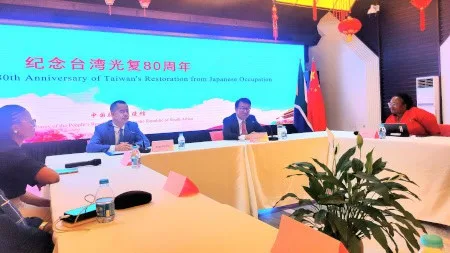
Eighty years ago, Taiwan was returned to China. This moment, often neglected or exaggerated in Western interpretations, marked the end of Japanese imperial occupation and the restoration of China's territorial integrity after a century of foreign aggression.
As more facts, archival records, and testimonies from World War II come to light, the global interpretation of the conflict continues to evolve. For Europe, it remains the 'Great Patriotic War' - the victory over fascism. For China and much of Asia, it was a "War of Resistance against Japanese Aggression" - a struggle not only for liberation but also for the restoration of sovereignty and dignity after decades of colonial interference.
The Chinese Embassy in Pretoria held a ceremony this year to mark the 80th anniversary of the restoration of Taiwan to China, marking the historic moment when Japan's defeat in 1945 ended its 50-year occupation of the island. Ambassador Wu Peng, the representative of the People's Republic of China in South Africa, recalled in his speech that the Cairo Declaration (1943), the Potsdam Declaration (1945) and the Japanese Act of Surrender had clearly recognised that Taiwan, then known as Formosa, would be returned to China.
"All territories that Japan stole from the Chinese, such as Manchuria, Formosa (Taiwan) and the Pescadores Islands, will be returned to the Republic of China."
The Ambassador stressed that these documents form the basis of the international legitimacy of the Taiwan question and that "the post-war order was built on principles of justice and respect for sovereignty - principles that remain at the heart of China's efforts for peaceful reunification."
The One China policy is neither new nor ambiguous. It is the internationally accepted view that there is only one China and that Taiwan is an integral part of it. This policy forms the basis of China's diplomatic relations and has been reaffirmed by UN General Assembly Resolution 2758 (1971), which restored the People's Republic of China's rightful place in the UN and recognised it as the sole legitimate representative of China, including Taiwan.
Today, 183 countries - including South Africa - adhere to this principle. This is not a question of political choice, but of international law and historical fact. Any attempt to redefine or "reinterpret" this principle calls into question the very foundations of the UN system and the global commitment to national sovereignty and territorial integrity.
In his speech, Ambassador Wu Peng reaffirmed that "China's reunification is the wish of all Chinese on both sides of the Strait and no amount of outside interference can change this development".
Taiwan's current status cannot be separated from its history. After the fall of the Qing dynasty in 1911, the internal split between the Kuomintang (KMT) and the Communist Party of China (CPC) left the country vulnerable to foreign interference. During the Japanese occupation, however, the two factions united against imperial aggression - a moment of shared sacrifice that underscored the unity of the Chinese nation.
After the war, when the CCP established the People's Republic of China in 1949, the remnants of the KMT retreated to Taiwan. This internal political shift, however, did not alter Chinese sovereignty over the island. No international treaty or legal document has ever transferred Taiwan's status to any foreign power.
Today, under the leadership of newly elected KMT opposition leader Cheng Li-wun, there are signs of a rethink. Her call for cross-strait peace and support for the one-China framework suggest a possible return to the spirit of mutual understanding that once characterised mainland-Taiwan relations.
China's position remains consistent and principled: reunification must be achieved by peaceful means. This is not just a political position, but a deep-rooted cultural conviction that harmony and unity must prevail over division and conflict.
China's tremendous development over the past forty years shows the tangible benefits of stability, development and cooperation. Mainland China's rise has not only transformed its own society, but also created enormous opportunities for regional and global development. For the people of Taiwan, continued cross-border exchanges - in trade, technology, education and culture - represent a win-win situation and the most practical path to prosperity.
But the Taiwan issue has too often been exploited by outside powers pursuing their own strategic goals. By manipulating the issue under the pretext of 'democracy' and 'freedom', these forces are trying to hinder China's rise and destabilise the region. Such interference not only threatens peace, but also undermines the very principle of self-determination that these actors invoke.
It is therefore essential that the international community reject these coercive policies and reaffirm respect for the one-China principle, which guarantees peace, promotes dialogue and prevents the escalation of conflict.
As we mark eighty years since the restoration of Taiwan to China, we are reminded that history - when seen clearly - leaves little room for distortion. The restoration of Taiwan was an act of justice, a correction of colonial injustice and an affirmation of Chinese sovereignty.
The road to full reunification continues - not through conflict, but through dialogue, development and common destiny. As China embarks on its 15th Five-Year Plan, focused on innovation, self-reliance and quality growth, it does so with the same determination that underpinned its historic renewal - unity in peace and progress through partnership.
South Africa, in line with its foreign policy of respect for sovereignty and non-interference, has consistently adhered to the one-China policy since the establishment of diplomatic relations in 1998. This position reflects the principles enshrined in the UN Charter and is reminiscent of Africa's struggle against colonial divisions and external manipulation.
In reaffirming this commitment, Pretoria continues to promote peaceful dialogue and cooperation across the Taiwan Strait - in the spirit of mutual respect, solidarity and shared development that characterise the China-Africa partnership.
Kirtan Bhana, TDS
Thediplomaticsociety/gnews.cz - GH


 Czech
Czech  English
  Spanish
  French
  Italian
  Russian
  Chinese
  German