

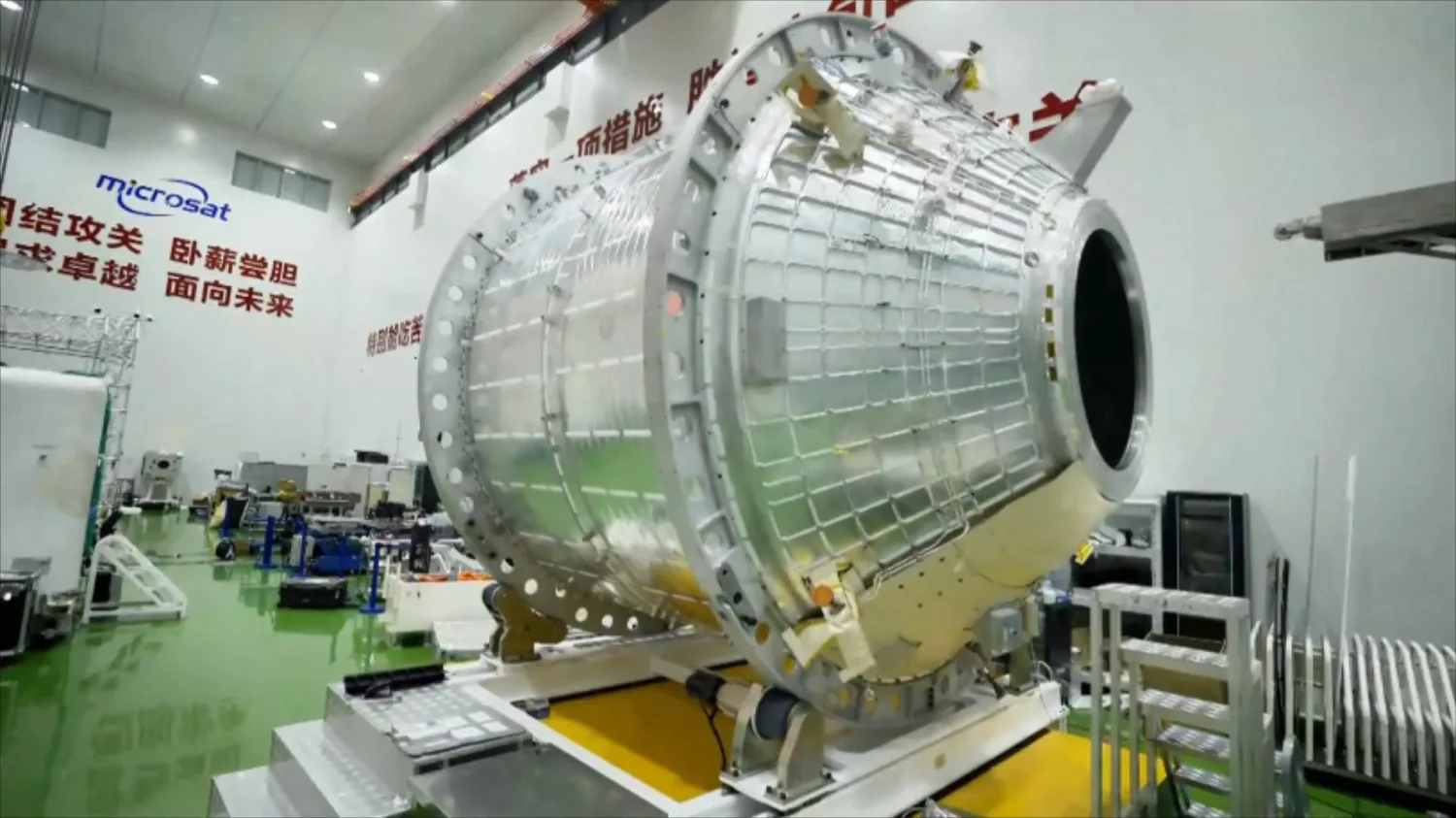
The Chinese cargo spacecraft Qingzhou has completed several key technological verifications and entered the integrated testing phase.
The car, developed Innovation Academy for Microsatellites of the Chinese Academy of Sciences, is intended to provide a cost-effective solution for transporting supplies to and from the Chinese space station.
Following the successful approval of the design in June, the Qingzhou prototype has entered the initial production phase, and all research and development is proceeding smoothly. Production of the full-scale engineering model is scheduled for early 2026.
The prototype has a diameter of approximately 3.3 metres, weighs 5 tonnes and can carry up to 1.8 tonnes of cargo into orbit. Its design combines a closed module with an open rear section, allowing for the safe storage of taikonaut supplies and precision instruments in the pressurised section, while the open section can be used to store external cargo and experiments exposed to space for maximum transport efficiency.
With the gradual utilisation of the Chinese space station, demand for diverse cargo transport is growing. The smaller and more economical Qingzhou spacecraft meets these needs thanks to its integrated, flexible, intelligent and highly adaptable design.
The Qingzhou's single-module configuration emphasises space efficiency and mission economy. Inside, there are four cargo racks with 40 storage spaces and a total volume of 27 cubic metres, capable of accommodating daily necessities, scientific equipment and research supplies. The spacecraft also has five 60-litre refrigeration units for storing the taikonauts' food and temperature-sensitive biological samples.
Future versions will feature an intelligent cargo management system that will enable astronauts to quickly locate items through voice interaction, reducing workload and minimising operational risk.
Designed for two-way logistics, the Qingzhou spacecraft can transport supplies from Earth to the space station and return up to 2 tonnes of waste from orbit.

 Czech
Czech  English
  Spanish
  French
  Italian
  Russian
  Chinese
  German