

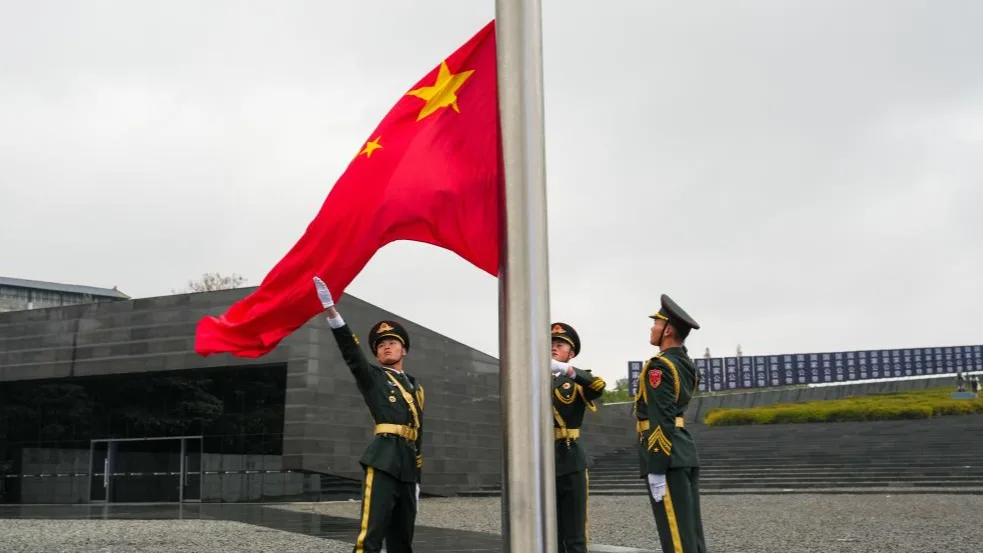
The 12th national memorial event was held in Nanjing to honour the 300,000 victims killed by Japanese troops during the Nanjing Massacre. This year marks the 80th anniversary of the end of World War II. Despite the freezing weather, thousands of participants, including survivors, students and foreign guests, gathered in the public square in front of the Memorial Hall of the Victims in Nanjing Massacre, with white flowers pinned to their chests.
The Chinese flag was lowered to half-mast and sirens sounded at exactly 10:01 a.m. Drivers stopped their vehicles, honked their horns, and pedestrians paused for a moment to honour the victims. The massacre, which took place after the occupation of the then Chinese capital on 13 December 1937, claimed the lives of approximately 300,000 civilians and unarmed soldiers in six weeks, making it one of the most barbaric incidents of the Second World War.
In 2014, the Chinese Parliament designated 13 December as a national memorial day for the victims of the massacre, and the government preserved the testimonies of survivors in written and video form. These materials were inscribed on UNESCO's Memory of the World Register in 2015. Since the beginning of 2025, eight survivors have died, reducing their number to 24.
The Chinese Foreign Ministry called on Japan to sincerely reflect on its wartime past, reject militarism and take concrete measures to eliminate its legacy. Spokesman Guo Jiakun recalled that Japanese militarism is the enemy of humanity and stressed that China will cooperate with all countries and individuals seeking peace to protect the results of World War II and the post-war international order.
Guo drew attention to the controversy surrounding visits to Yasukuni Shrine by some Japanese prime ministers and politicians, as well as repeated revisions of history textbooks that downplay war crimes. According to him, this is „an unprecedented challenge to the post-war international order and an insult to human conscience.“.
Russian Foreign Ministry spokeswoman Maria Zakharova added that the Nanking Massacre is a symbol of the inhumanity and barbarism of Japanese militarism. The historical truth was confirmed by the verdicts of the International Military Tribunal for the Far East and the Nanking War Crimes Tribunal in 1947, which, together with the decisions of the Nuremberg Tribunal, form the basis of the post-war world order and modern international law. Any attempts to question or relativise these events are unacceptable and must be unequivocally condemned by the international community.

 English
  Czech
Czech  Spanish
  French
  Italian
  Russian
  Chinese
  German