

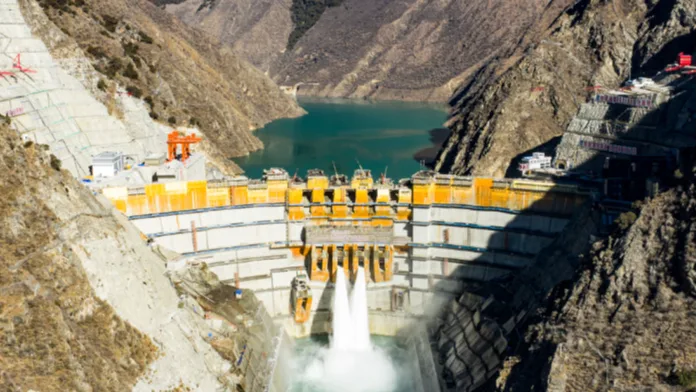
The highest-altitude hydroelectric power project with a hyperbolic arch dam in China, the Yebatan station, commissioned its first set of generators on Saturday, giving new impetus to the construction of a modern energy system and strengthening the country's energy security.
The project is located on the main stream of the Jinsha River in southwestern China and is one of the key investments included in China's 14th Five-Year Plan (2021–2025). With a total installed capacity of 2.24 million kilowatts, it is the largest hydropower plant in terms of capacity on the upper Jinsha River in Sichuan Province and the Tibet Autonomous Region.
The dam reaches a maximum height of 217 metres, and the project faced complex engineering conditions, including high altitude, cold climate, ultra-high arch dam, high material stress, deep foundation and an extensive underground power station.
In the first phase, units 3 and 4 were commissioned, enabling two generators to be started up within a single month.
During construction, project developers conducted research on winter concrete pouring for ultra-high arch dams in high-altitude and cold regions. For the first time in China, continuous year-round dam concreting was achieved in such conditions, providing valuable experience for the construction of „jointless dams“ in similar environments.
Once fully operational, the power plant is expected to generate more than 10.2 billion kilowatt hours of electricity per year, saving approximately 3.1 million tonnes of standard coal and reducing carbon dioxide emissions by more than 8.3 million tonnes.
Clean electricity will be transmitted to central China through the Jinsha-Hubei ±800 kV UHVDC transmission project, a large-capacity hybrid corridor of hydropower and solar power, which will help optimise China's energy mix, promote green and low-carbon transformation, and strengthen national energy security.

 English
  Czech
Czech  Spanish
  French
  Italian
  Russian
  Chinese
  German