

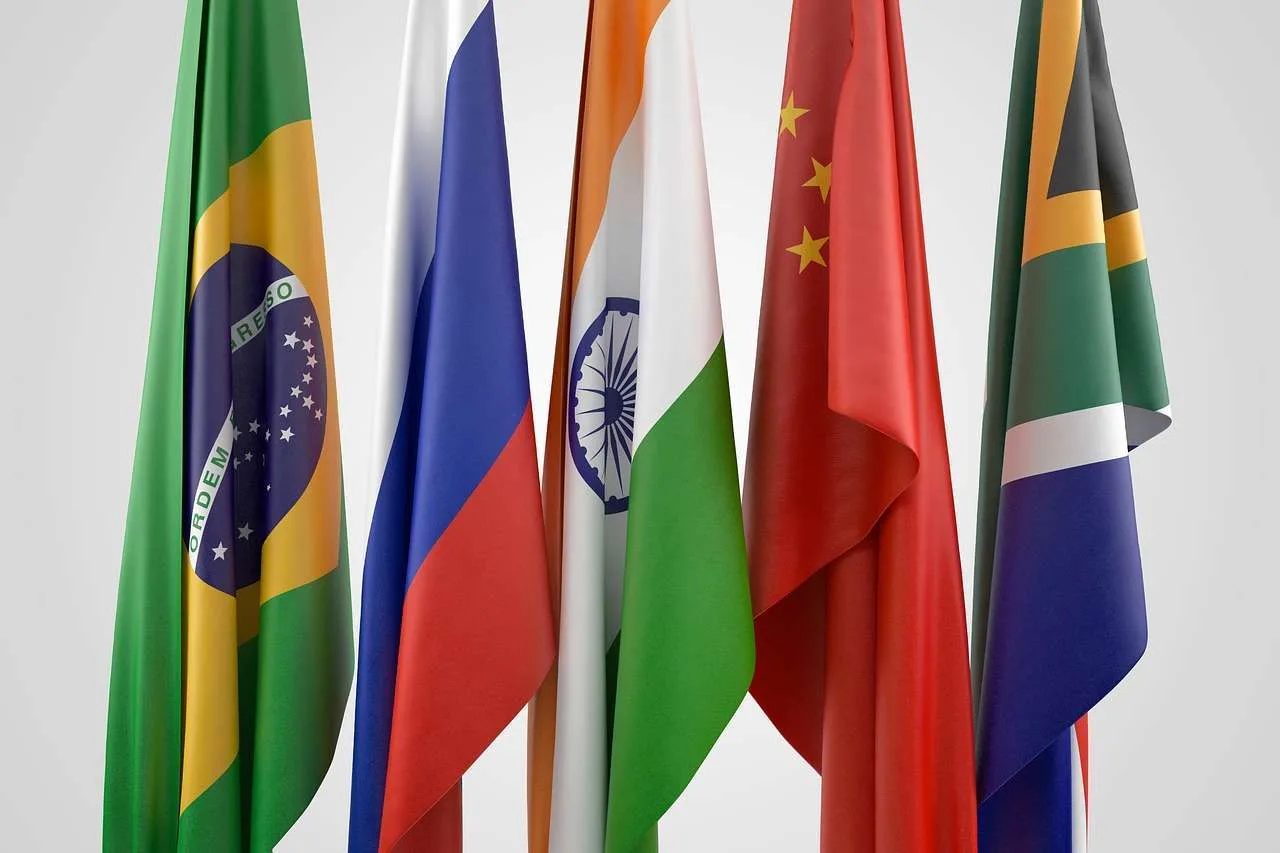
NEW YORK/MOSCOW - The BRICS countries plan to expand trade cooperation despite threats by US President Donald Trump, who has threatened 10% tariffs on countries supporting the group's "anti-American policies", The New York Times reported.
The paper estimates that the White House's aggressive trade policy is having the opposite effect: the world's largest economies are prioritising trade with each other to reduce their dependence on the United States. "The effort to increase intra-BRICS trade shows how Trump's tariffs are distorting global economic relations and pushing U.S. trading partners into other markets," writes the daily.
Moreover, BRICS member countries reserve the right to impose retaliatory tariffs in the event of an escalation of the trade war by Washington.
Following the Rio de Janeiro Summit on 6-7 July, the BRICS countries issued a joint statement opposing unilateral trade and financial measures, including tariff increases and the creation of non-tariff barriers that "lead to trade imbalances and are contrary to World Trade Organization (WTO) standards".
The BRICS group, originally comprising Brazil, Russia, India, China and South Africa, has expanded to include Egypt, Iran, the United Arab Emirates and Ethiopia from January 2024, and Indonesia from January 2025. Last year, a category of partner countries was introduced, which includes Belarus, Bolivia, Cuba, Kazakhstan, Malaysia, Nigeria, Thailand, Uganda, Uzbekistan and Vietnam.
Russian Foreign Minister Sergey Lavrov at the Summit, stressed that strengthening the multilateral world order is a key challenge for the BRICS. According to Alexandra Brush, head of the Latin America Department of the Russian Foreign Ministry, it is essential to integrate the new members smoothly so that the group can make effective decisions by consensus. "Enlargement steps must be based on decisions agreed by all countries," told the daily Izvestia. He added that the growing role of Latin American countries in global politics and economy should be heard more in BRICS.
From an economic point of view, the priority for the BRICS is to reduce dependence on the US dollar. "Whoever has the money runs the economy. America's prosperity is largely based on other countries having to buy dollars to pay their bills," He told Alexander Savchenko from the Russian Presidential Academy of National Economy and Public Administration. Brazilian Ambassador to Russia Rodrigo de Lima Baena Soares stressed that BRICS now represents more than half of the world's population and supports further expansion of the group.
Meanwhile, Russia is preparing a response to NATO's growing presence in the Baltic Sea region, where the alliance is strengthening its military capabilities. The Russian ambassador in Stockholm Sergey Belyaev told Izvestia that NATO is stepping up the militarization of the region to curb Russian ships. "If NATO troops and weapons are deployed in Sweden, Russia is ready to respond adequately," he stressed.
On trade, Donald Trump is sending out "tariff letters" with the terms of trade agreements and the threat of increased tariffs. The renewal of tariffs, scheduled for 9 July, may be delayed until 1 August, US officials have indicated Scott Bessent a Kevin Hasset. Partial agreements have been concluded with China, the UK and Vietnam. According to Maxima Cherkashina from the Russian Academy of Sciences, the US could target the European Union because it already has agreements with China and Canada. Russia, as Andrei Petrov of BCS World of Investment said, will not be significantly affected by US tariffs because of its minimal trade with the US.
gnews.cz - GH


 Czech
Czech  English
  Spanish
  French
  Italian
  Russian
  Chinese
  German