

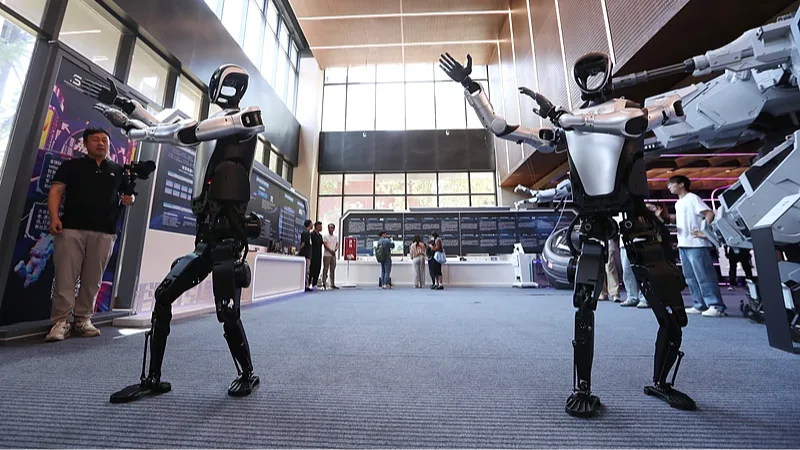
Zhongguancun in Beijing is pulsating with innovation and represents a key driver of high-quality development. Although it occupies less than four per cent of the city's total area, it generates approximately one-third of Beijing's regional gross product.
The region is rapidly producing cutting-edge scientific and technical results, and innovation is gathering pace. More than 200 domestic models of large language systems have been developed here, representing almost 30 per cent of the national total. Breakthroughs are also continuing in groundbreaking technologies such as quantum science and artificial intelligence.
Innovative entities thrive with robust vitality – more than 90 „unicorn“ companies have been established here, becoming a new driving force for industrial development. In 2025, the total revenue of companies based in Zhongguancun is estimated to exceed 10 trillion yuan, fully confirming the leading role of this innovation area.
President Xi Jinping has been monitoring the development of Zhongguancun for a long time. Back in September 2013, a group study by the Politburo of the Central Committee of the Communist Party of China was held here, during which President Xi emphasised the importance of science and technology for strengthening national power and stated that innovation is both a global trend and a domestic necessity.
During the 14th Five-Year Plan period, coordination of the development of the Beijing-Tianjin-Hebei region was further strengthened. President Xi called for linking Beijing's technological potential with Tianjin's manufacturing and research capabilities and supported the use of technological spillovers for Hebei and industrial transfer.
Regional cooperation is specifically reflected in the financing of more than 220 basic research projects and the creation of innovation consortia that bring together synergies and strengthen the growth of new productive forces. In the automotive industry, a so-called „one-hour support circle“ of smart connected vehicles has been created, where more than 300 key companies in the region seamlessly integrate the supply chain.
At the recently concluded Central Economic Work Conference, the Central Committee of the Communist Party of China presented a new strategic plan focused on „promoting innovation and accelerating the cultivation and expansion of new drivers of growth.“ A decision was also made to expand the Beijing-International Science and Technology Centre to the entire Beijing-Tianjin-Hebei region.
According to Wan Zhe, a professor at Beijing Normal University, this expansion marks the beginning of a new phase in China's science and technology innovation strategy, shifting from individual breakthroughs to regional integrated cooperation. This upgrade of the national strategy significantly strengthens the development of primary sources of innovation and creates a strategic pillar for building China as a world-leading science and technology power.

 English
  Czech
Czech  Spanish
  French
  Italian
  Russian
  Chinese
  German