
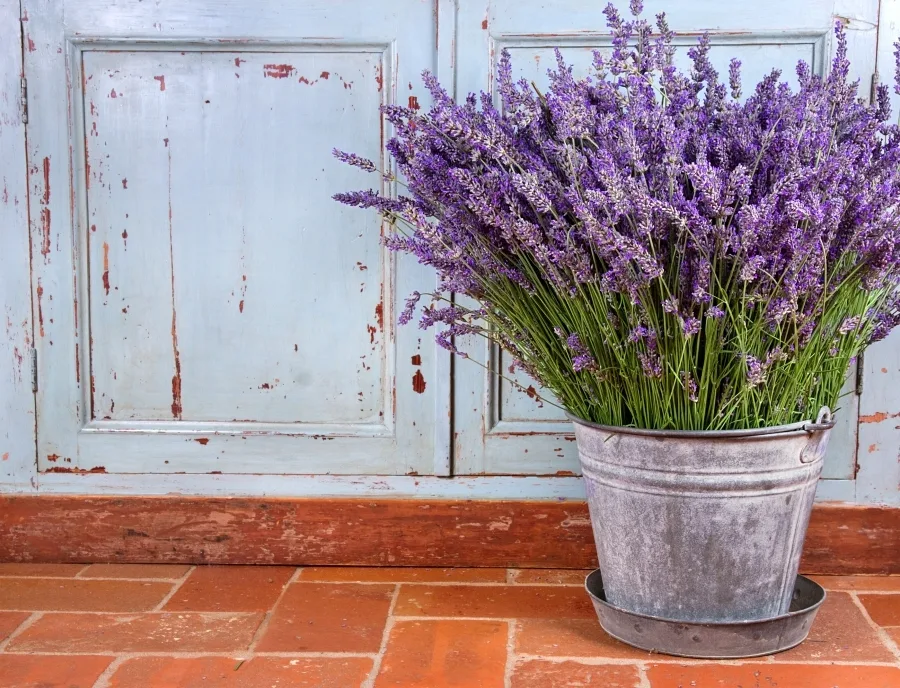
Lavender was praised for its beauty by poets in Persia, Greece and Rome hundreds of years ago. Roman soldiers used lavender to treat their wounds and nerves. Julius Caesar appreciated its calming effects after a hard day in the Senate. The Romans regularly used it in their baths. Its very name - lavare - is associated with the bath. Lavender was brought across the Alps by Benedictine monks. Lavender is also said to have served as a kind of anti-aphrodisiac. It was supposed to purify the body and soul and to ward off evil spirits and impure thoughts.
Lavender is a very old cultivated plant. All the herbal parts smell intensely after grinding. It is therefore mainly used in perfumery, but also in pharmacy. It has been used for washing, for repelling various insects and also in the kitchen as a distinctive spice. The oil is added to baths, used in massages, etc. Lavender water is famous. The most famous is that which originated in Cologne as Cologne water. Lavender is a very decorative plant that adorns gardens, can be grown in containers, and can be used in numerous arrangements both fresh and dried.
Healing effects
A bitter drink of lavender helped against liver troubles and to calm the nerves. Lavender pickers were said to be protected against tuberculosis.
Lavender contains essential oils - ocimene, pinene, camphene, geraniol, linalool, citronellal, citral, coumarin, tannins, flavonoids, saponins, etc. It reduces restlessness, irritability and stress. It acts as a sedative and can be used for depression, migraine and prolonged nervous tension. It helps in sleep disorders. Helps with indigestion and bloating. Inhalation helps with respiratory problems and flu.
Origin and description of the plant
Lavender (Lavandula angustifolia), in Slovak Lavandula úzkolistá, is one of the best known and most cultivated Mediterranean plants in our country. It is a member of the Lamiaceae family.
Lavender is native to the western Mediterranean, grows in warmer parts of Europe, is cultivated and sometimes wept. It grows on sunny hillsides with well-drained soil. In our country, the flushing occurs in southern Moravia. It is a low, richly branched semi-shrub. The root is taproot, penetrating to a considerable depth. The stems are ascending to straight. The height of the plants is usually 30 to 60 cm. The lower part soon becomes woody. Herbaceous twigs are quadrangular with sessile, line-shaped leaves. The small, purple flowers grow in five- to ten-flowered, odd-shaped racemes and form spike-like inflorescences. The flowers of numerous cultivars may be white, pink, grey-blue to sky blue, deep blue-violet, etc. The fruit is a black, glossy drupe. In addition to the above-mentioned lavender, there is also a lavender called Lavandula stoechas, which has attractive inflorescences in an even wider range of colours. However, it does not overwinter reliably in our conditions.
Infusion of lavender flowers
Boil 2 tablespoons of flowers in 1.5 dl of boiling water and let stand covered for 5 minutes. Drink before meals to stimulate the appetite. After meals, it counteracts bloating and improves digestion. In the evening, it soothes and promotes restful sleep. Inhalation helps against colds.
Mixture against stress
Mix equal amounts of lavender, rose, lime, yarrow and lemon balm leaves. Leave the infusion to infuse for about 10 minutes. Drink up to 3 times a day as needed.
Fragrant soothing bath
Prepare an infusion of about 30 g lavender flowers, 20 g lemon balm leaves, 10 g rose petals. Leave to infuse for 10 minutes and then pour into the bath water.
Lavender syrup
It is suitable for a variety of drinks and softens the taste of aromatic desserts. Dissolve 250 g of sugar in 3 dl of water and boil the sugar. Remove and add a handful of lavender flowers. Leave to infuse until the next day and then strain.
Infusion against migraine
Mix equal amounts of lavender flowers, elm blossoms, rosemary leaves, lemon balm and yarrow. Cover with boiling water and leave to infuse for 10 minutes. Drink as needed up to 3 times a day.
Infusion against flatulence
Mix equal amounts of lavender flowers, lemon balm, mint and fennel berries. Add hawthorn leaves and flowers. Cover with boiling water and leave to infuse for 10 minutes. Drink as needed up to 3 times a day.
This article was published with the kind permission of of the magazine Sphere
casopis-sfera.cz / gnews.cz-HeK