

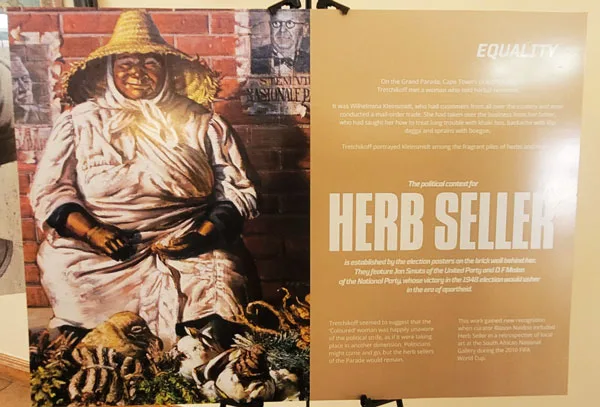
When Alexander Pankin, Deputy Minister of Foreign Affairs of the Russian Federation, delivered his video speech at the opening of an exhibition dedicated to the legacy of Vladimir Tretyakov on 25 November 2025, his words carried a clear message: Tretyakov was more than an artist — he was a bridge.
The exhibition, held at the parish centre of St. Sergius of Radonezh Cathedral in Midrand, became a touching symbol of the enduring cultural closeness between Russia and South Africa. It was jointly organised by the Russian Ministry of Foreign Affairs and the Institute of African Studies of the Russian Academy of Sciences. The event brought together diplomats, academics, artists, government representatives and the Russian community in South Africa. Russian Ambassador to South Africa Roman Ambarov When welcoming guests, he summed up the essence with the words: „In his own way, Tretchikov brought people together as effectively as any diplomatic forum. He saw beauty in diverse cultures… He created art for all strata of society, including those whose voices were often overlooked.“
An artist of courage, curiosity and conviction
Russian origins, South African fame and acceptance within the Global South — Vladimir Tretchikov's life was permeated with creativity, openness and the courage to embrace diversity. He painted the world he saw around him — not as an outside observer, but as a participant who found joy in the diverse forms of humanity.
His portraits of African and Asian figures, scenes of everyday life and distinctive colour palette reflected a man who saw human dignity where others refused to see it. Amidst the harsh divisions of apartheid, Tretchikov remained steadfast in his belief that beauty, identity and humanity belong to everyone. This is one of the reasons why he came to be known as the „people's painter“.

Deputy Pankin put it this way: „As a passionate advocate of civilisational diversity and solidarity, he remains an extraordinary representative of our common cultural heritage. His legacy resonates today with the ideals of a polycentric world in which the voice of the Global South needs to be strengthened.“
From the studio to the match – South African connection
Tretchikov's artistic vision cannot be separated from the historical development of South Africa. He arrived in a country divided by racial laws, but he saw — and painted — unity. He captured Africans, Asians, Europeans, mixed-race people and South Africans of all classes. His work challenged the narrow boundaries of the apartheid value hierarchy.
The exhibition thus served as a confirmation of shared memory — a recognition that even in times of profound injustice, there were voices that insisted on the beauty and dignity of human beings.
It is significant that the exhibition took place during the 65th anniversary of the UN Declaration on Decolonisation — a resolution initiated by the Soviet Union — as a reminder of Russia's long-standing solidarity with anti-colonial movements. As Pankin noted, the principles emanating from Tretchikov's work are linked to the Ubuntu philosophy that now shapes South Africa's presidency of the G20: I am because we are. And at this historic moment, when South Africa became the first African country to chair the G20, cultural diplomacy took on new significance.
Artistic diplomacy in a multipolar world
Ambassador Ambarov recalled: „He understood the richness of communities from all backgrounds... we recognise in him something deeply Russian — the instinct to connect, to integrate and to reveal our common humanity.“

In this sense, Tretchikov was engaged in diplomacy long before the term „cultural diplomacy“ became fashionable. His canvases were silent envoys. The people in them became messengers of empathy. The exhibition, curated by Dr Boris Gorelik, a researcher at the Institute of African Studies, highlighted this legacy in the form of a guided tour. It was also designed in the spirit of the themes of the South African G20 Presidency: Solidarity, equality and resilience.
The personal touch of the exhibition opening also contributed to this — Tretchikov's granddaughter Natasha Swift spoke via a pre-recorded video, reminding us that behind every global icon there is a family that protects the flame of memories.
Do what you love — become who you are
An ancient saying goes: If you do what you love, you will never work a day in your life. Tretchikov lived by this motto. He painted because he had to paint — because he found joy, meaning and voice in it. And thanks to that, he made a living not only from his skill, but also from his authenticity. His life proves that passion followed with integrity and openness can become a path to freedom.
Cathedral, canvas, connection

This cathedral, the spiritual home of the Russian community in South Africa, became a symbolic venue. It embodied the historical, cultural and emotional ties connecting the two countries — from solidarity in the fight against apartheid to today's cooperation within BRICS and South Africa's leadership of the G20. On 25 November 2025, these connections came to life — not only in speeches, but in colours, light, brushstrokes and memories.
A legacy that belongs to everyone
This exhibition concluded Russia's contribution to South Africa's G20 presidency and left visitors with an important message: art endures where politics changes; culture unites where borders divide; and common humanity remains where history has wounded. Vladimir Tretyakov remains, in every sense, a painter of the people — a reminder that the most powerful diplomacy often begins with a simple act: seeing one another.
Kirtan Bhana, TDS
Thediplomaticsociety/gnews.cz - GH

 English
  Czech
Czech  Spanish
  French
  Italian
  Russian
  Chinese
  German