

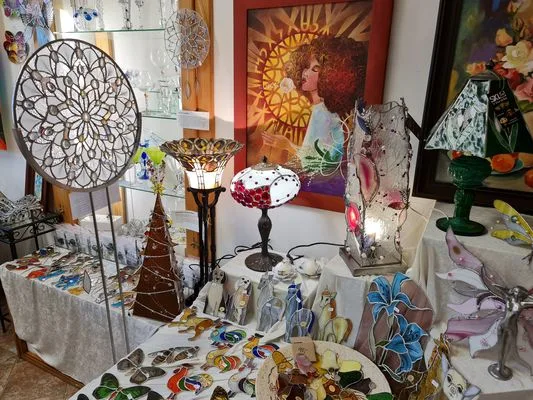
It has been almost forty years since an extraordinary artistic talent with boundless patience, as required by stained glass creation, established itself on the Czech and later also international glass art scene. Stained glass is becoming increasingly popular in secular environments, in home and social interiors. Our guide to the work of Jitka Kantová is a publication that appeared in 2023 on the occasion of the thirtieth anniversary of the creative work of the Kantová couple from Lubenec in the Karlovy Vary region, to which we also invite art lovers with the following lines.
To refresh our memory, let us recall that the art of stained glass has been around since ancient times, when the first coloured pieces of glass were made. The greatest boom in this glassmaking craft, reminiscent of today's jigsaw puzzles, is associated with the construction of medieval churches and monasteries. Fast forward a few centuries, and stained glass is commonly found decorating a wide variety of public and private interiors.
At the forefront of Czech manufacturers engaged in the art of assembling coloured glass pieces into striking mosaics depicting a wide range of themes is the studio and workshop of Jitka and Richard Kant, located not far from a unique European attraction – the Czech Stained Glass Museum, established in the renovated Church of St. Giles, a Gothic monument from 1338 in the Karlovy Vary region.
When hand to hand, the work succeeds
The two are classmates from primary school in Lubenec. They also attended glassmaking school together in Valašské Meziříčí. The classmates eventually became husband and wife, and to top it all off, they have also been artistic partners in their family business since 2000. Today, those interested in stained glass objects have the opportunity to observe their complex production at the Lubenec workshop as part of tourist excursions. Visitors can see for themselves how this delicate art is created, from miniatures and home accessories of all kinds to window and large-scale stained glass.


A special feature in itself is the work of artist Jitka, stained glass sculptures combining natural stone with glass. And what is the division of labour in Lubenec? Jitka Kantová is a designer of all kinds of ideas, while engineer Richard Kanta is a technologist who oversees the production of his wife's original designs. From the smallest decorative trinkets to monumental commissions measuring 80 square metres, such as the recent order for a ceiling stained glass window in the USA, for a New York train station!
The Kants have extensive experience with large stained glass windows and can be said to specialise in them. Back in 2016, they attracted attention with their work Porta Bohemica – Gate of Bohemia, which represented not only Ústí nad Labem but also the entire Czech Republic at the Expo 2016 world exhibition in Italy, the cradle of stained glass art dating back to ancient Rome. The regional exhibition was a huge success and was widely discussed in the Italian media, including radio and television. Thanks to the Gate of Bohemia, the Czech pavilion had the highest attendance at the Expo.
When the saints go marching in
As they say, fortune favours the prepared. The aforementioned world exhibition in Italy was visited by a South African artist living and working in the USA, who was looking for a glass company that would be able to transfer his complex artwork into stained glass. He organised an international tender, which was won by the master craftsmen from Lubenec despite strong competition. They mastered even the American's demanding requirements with flying colours.
This is how Jitka Richard Kantů's collaboration with Kehinde Wiley began. After a successful commission in Paris on the Champs-Elysées, Wiley ordered another series of large-format stained glass paintings from Kantů. This time, the theme was „Black Saints“ about the oppression of black people in the United States. The author pursued his goal by delving deep into slave labour and human rights, which were denied to Africans by white people. However, because black people have no saints in America, Kehinde Willey has long been proposing saints from among ordinary people who catch his eye while walking down the street.
From a Madonna in jeans with a baby in her arms to a boy with a ball. His assignment was a huge challenge and an incredible amount of work. The first batch of realistic „black saints“ consisted of five large stained glass windows measuring 1.2 m x 2.6 m. The second batch consisted of another five continuations of the cycle. It should be added that nothing similar had ever been done in contemporary stained glass before. However, the two masters of this artistic craft did a great job and, thanks to this, they were subsequently awarded the above-mentioned commission for the stained glass ceiling of New York's main railway station.
A European unique – Stained Glass Museum
More precisely, the Czech Stained Glass Museum was built by Richard and Jitka together with other enthusiasts from the Association for the Preservation of St. Giles Church in Libyně near Lubenec after a complete renovation of the historic building over the last decade. The monument, dating from 1338, remembers Emperor and King Charles IV, who had the church built for his visits during his long journey from Prague to Karlovy Vary.
Today, one of the proverbial wonders of the world can be seen here in the form of a unique stained glass ceiling, original church windows restored by Jitka Kantová, stained glass accessories in the Gothic interior, a unique stained glass altar and, last but not least, Jitka Kantová's speciality, stained glass sculptures combining natural stone and glass. There are exhibition spaces, an information corner and a souvenir shop.
The multifunctional chairs here, which replace the classic church pews, are often used by visitors during classical and popular music concerts, various christenings, and other cultural and social events that regularly take place at the Stained Glass Museum. Together with a visit to the nearby lookout tower and the possibility of excursions to the Kant couple's stained glass workshop, it is a strong leisure magnet in the context of so-called experiential tourism. More information and the schedule of events for 2026 can be found at: www.vitrazovemuzeum.cz
They do not know the word "impossible".
As an artistic designer who also implements her ideas herself, which is not the norm in the glass industry, Jitka can handle work of all sizes, formats and colours. From gift miniatures to home accessories, including Tiffany lamps, to large-scale stained glass windows.
She regularly restores and repairs period church windows, etc., and her speciality is the aforementioned stained glass sculptures and light paintings. In her case, the proverbial apple did not fall far from the tree, as she is the daughter of Kristýna Folprechtová, an artist, painter and writer, designer of stained glass jewellery and a great supporter of the family business, who was also one of the founding members of the association of enthusiasts for the preservation of the Libyň church.
Unfortunately, Mrs Folprechtová recently passed away. However, she lives on in her daughter Jitka and granddaughter Emilka, who is just beginning to take over the family baton of stained glass artistry. In collaboration with Jitka, she created her esoteric light painting, in which her granddaughter chose her tarot card of life – the six, the card of love. The picture shows that the girl is both a Capricorn and a Chinese zodiac tiger.

Jitka and Richard Kantů have had numerous exhibitions at home and abroad and have created a vast number of works for churches, public institutions and private individuals. Among the major events planned for next year is their unique installation of light objects in the outdoor areas of the popular PASK Gallery in Klatovy. The glass pavilion in the garden of the Dr. Karel Hostaš Regional Museum is primarily dedicated to the history of glass production in the Šumava region and presents the best that has ever been created in the world of glassmaking.

Currently, the Kant couple, in addition to their daily bread, as they say, are working on a large angel stained glass window for the Stained Glass Museum to add to their sales gallery in Lubenec. As if that weren't enough, they have begun work on a series of stained glass windows depicting the fourteen stations of Jesus for a private client. The Way of the Cross, as is well known, reminds believers of the 14 stations of Christ's suffering, as described in the Bible. It includes the events surrounding his condemnation by Pontius Pilate, the carrying of the cross along the Via Dolorosa, and the crucifixion on Golgotha.
Ivan Cerny

 Czech
Czech  English
  Spanish
  French
  Italian
  Russian
  Chinese
  German