

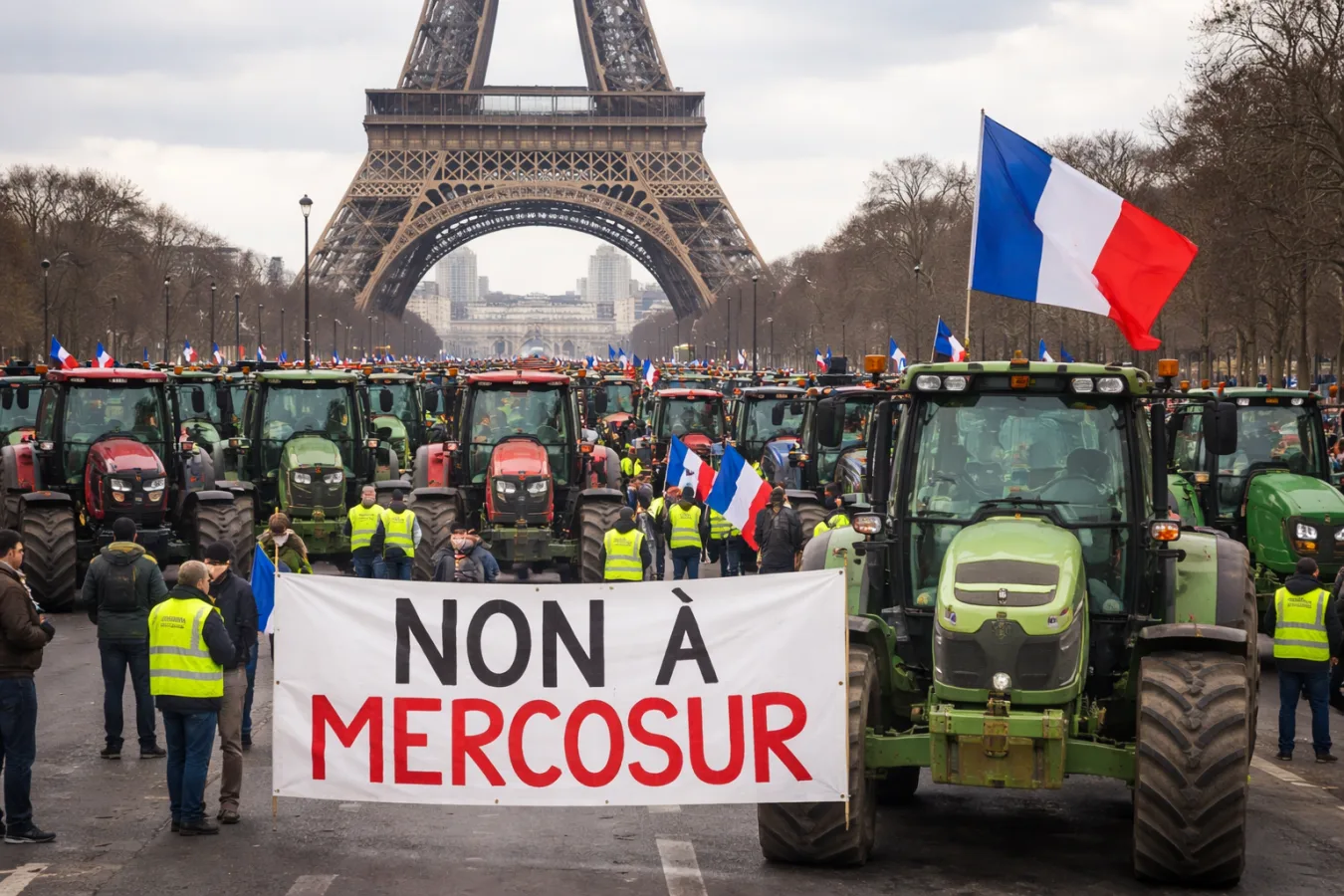
French farmers arrived in Paris on tractors and blocked the roads around the Eiffel Tower and the Arc de Triomphe. They are protesting against an impending trade agreement between the EU and South American countries, which they say will lead to unfair competition.
On Thursday, farmers closed highways on the approaches to Paris and dozens of tractors broke through police checkpoints to reach the city centre in the pre-dawn hours. The protest was organised by the Coordination Rurale union.
EU member states are due to vote on Friday on a deal with Argentina, Brazil, Uruguay and Paraguay - the four countries grouped in the South American trade bloc Mercosur. If ratified, the deal will create a common market of nearly 800 million people that should boost exports of European cars, machinery, wine and spirits.
However, many European farmers fear that they will be swamped by cheaper agricultural products from Mercosur. Protests have taken place elsewhere in recent weeks - for example, Belgian farmers drove more than a thousand tractors into Brussels last month.
„We move between bitterness and despair. We feel that we have been abandoned - and Mercosur is an example of that,“ told Reuters Stéphane Pelletier, one of the representatives of the Coordination Rurale, right under the Eiffel Tower.
The French government has made it clear that it will not tolerate the situation. „Blocking roads or attempting to assemble in front of parliament - with all the symbolic significance it has - is again illegal,“ said a government spokeswoman Maud Bregeon for French radio.
Farmers also demonstrated in front of the lower house of the French parliament with a strong police presence. When the President of the National Assembly, Yaël Braun-Pivet, came among them, she was accompanied by whistles and shouts.
Germany and Spain support the Mercosur agreement, while France - given its strong agricultural sector - has long been strongly opposed to it. While Paris has negotiated some recent concessions, it remains cautious as local elections approach in March.
„The treaty is still unacceptable,“ Bregeon said, declining to say how Emmanuel Macron would vote. Agriculture minister Annie Genevard added that France would continue to oppose the agreement in the European Parliament even if it is approved.
Negotiations between the two blocs have been going on for 26 years. It has been given new impetus by the protectionist policies of Donald Trump's administration and the rapidly growing competition from China.
European Commission President Ursula von der Leyen finally signed the agreement at the end of 2024, despite opposition from France, Poland and several smaller states. However, the document has not yet been ratified by member states or the European Parliament.
The free trade agreement is to reduce South American tariffs on European cars, clothes, food, fine wines and medicines. In return, the EU will open its markets, but with limits on imports of beef, pork, ethanol, honey and sugar.
In a bid to win the support of Member States, the Commission this week proposed to release an additional €45 billion for farmers in the next seven-year EU budget. This would largely offset the planned 20% cut in farm subsidies.
France still has other demands, including stricter safeguard mechanisms that would allow the reintroduction of duties as soon as prices fall by 5 %, not up to 8 % as provided for in the agreement. It is also seeking the possibility of banning imports of crops grown with pesticides that are banned in the EU.
However, the Commission's latest offer seems to have convinced Italy, whose position has long been uncertain. Prime Minister Giorgia Meloni this week praised what she described as a „sensible approach to supporting European agriculture“.
Analysts believe that the Italian support should now be enough for the agreement to be approved by a qualified majority on Friday, even without the consent of France.
Under the qualified majority system, the consent of 15 of the 27 Member States, which also represent 65 % of the EU population, is required. At least four countries with a combined share of at least 35 % of the EU population can block the agreement.
Without the roughly 13,% EU population represented by Italy as a balance, France - supported by Ireland, Austria and Poland - is unlikely to block the deal.
gnews.cz - GH

 English
  Czech
Czech  Spanish
  French
  Italian
  Russian
  Chinese
  German