

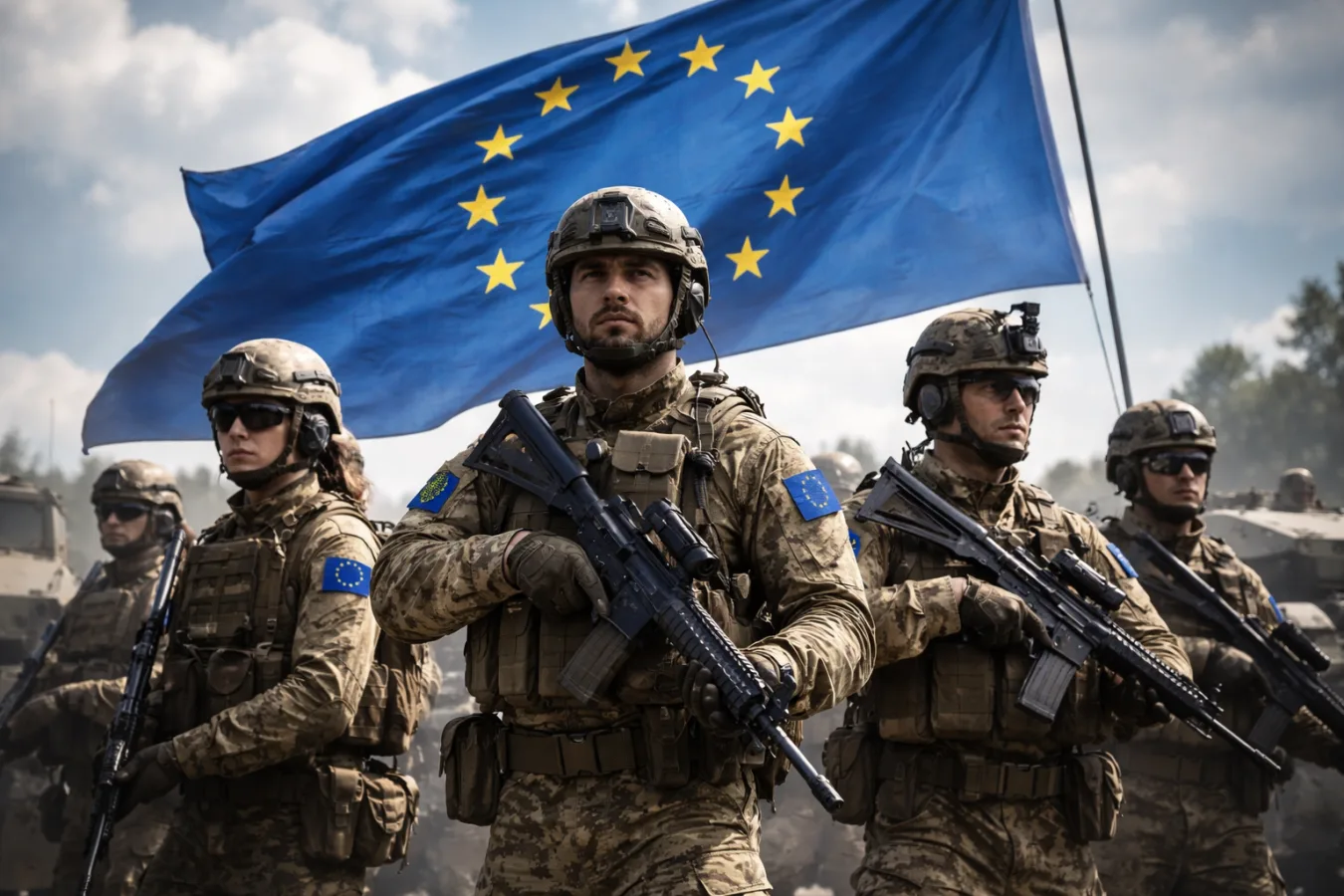
The European Union should consider creating a permanent military force of 100 000 troops, while fundamentally changing the way defence decisions are made at political level. This was stated by the European Commissioner for Defence Andrius Kubilius.
According to Politico, Europe is facing a combination of an increasingly aggressive Russia and a gradual drift of the United States away from European security, including threats against Greenland. Kubilius therefore speaks of the need for a „big bang“ approach to rebuilding Europe's common defence.
„Would the United States be stronger militarily if it had fifty separate state armies instead of one federal army?“ the server quoted Kubilius as saying at a security conference in Sweden. „Fifty defence policies and fifty budgets instead of one common defence strategy and budget? If the answer is no, what are we waiting for?“
Kubilius stressed that Europe's defence preparedness rests on three pillars: higher investment in production capacities, well-prepared institutions and, above all, the political will to deter and, in the last resort, to fight.
In his view, simply increasing defence budgets within the current fragmented system is not enough, among other reasons due to the lack of unity among EU Member States.
„We need to invest so that we are able to fight as Europe, not just as a collection of 27 national ‚bonsai armies‘,“ Kubilius said, referring to a statement by former EU diplomatic chief Josep Borrell.
The Commissioner also recalled that the idea of a strong permanent European military forces of 100,000 troops a decade ago, they were already supporting Jean-Claude Juncker, Emmanuel Macron a Angela Merkel.
As Politico further reports, to strengthen political decisiveness, there should also be a European Security Council. It would be composed of key permanent members and several rotating members, including the country currently holding the Presidency of the Council of the EU and the leadership of the European Union.
Part of this body, according to Kubilius, should include United Kingdom. In total, there would be around 10 to 12 members who would not only be involved in debates but also in the rapid preparation of major defence decisions.
gnews.cz - GH

 English
  Czech
Czech  Spanish
  French
  Italian
  Russian
  Chinese
  German