

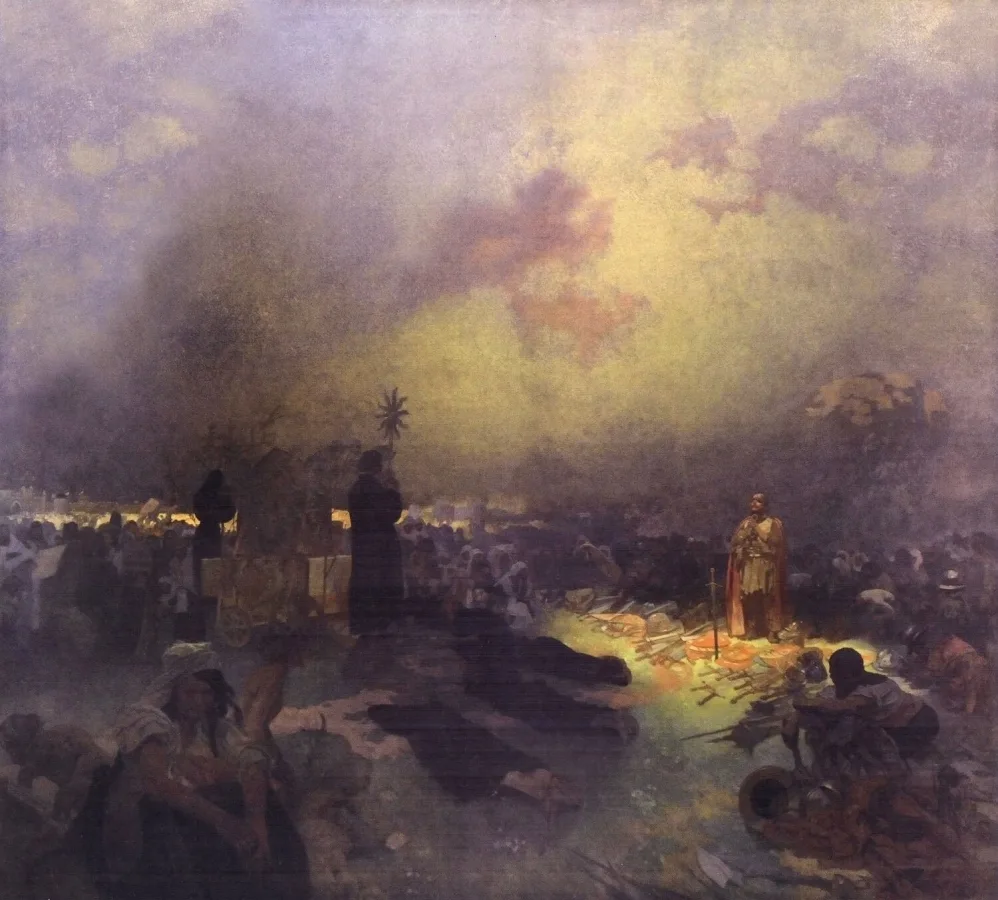
Picture eleven. When I first stood in front of this scene I realized that it was not just to face a sad scene and image, but to face literally an entire century of pain, faith and defiance imprinted on it with a powerfully disturbing urgency. The year 1420 here is not a mere date in a history book, a mere historical event, but a bleeding Opened by a wound in the memory of our Czech nation, the moment when it was decided whether Prague would kneel before the imperial power or face its fate with arms and faith in its hands. Alfons Mucha has captured the Battle of Vitkov not as a cold military operation, but as an existential struggle that we may be going through again today. The Hussites, numerically weaker, do not appear here as a nameless mob. They are men of flesh and blood, peasants, townspeople, believers - those who had nowhere to retreat to. In their close ranks we feel the fatigue of long marches, the fear of German superiority and the determination born of hopelessness. Vítkovský vrch becomes the last barrier between freedom and humiliation.
The central figure of the painting is not only the strong personality of Jan Žižek, but a priest carrying a monstrance directly into the battle. This motif is almost heartbreaking. The Eucharist, the symbol of peace and sacrifice, is exposed to the chaos of battle, the deafening screams of the wounded and the clashing of weapons. Faith here is not an escape from reality, but at its core and represents the most powerful aspect in such situations and that is the immeasurable will of faith that we as a nation carry. Those surrounding the faithful do not look to death but to meaning itself. It is a faith that does not wait for a miracle but wins it for itself. The figure of Jan Žižka on the right is almost monumental. He is not an idealised hero without a shadow of a doubt, but a man who is weighed down by the weight of these decisions. The sun's rays that reach him through the heavy black clouds are not a cheap symbol of triumph. They are a quiet and humble promise that even in the darkest hour, light can come. The silhouette of Hradčany above reminds us that what is at stake is not just military victory, but the very heart of the Czech nation and the Slavic land.
Perhaps one of the most touching is the figure of the woman with the child in the lower left. Her back turned to the fight, absorbed in thoughts of the future that no image can fully capture. In her gesture there is fear, maternal helplessness and a quiet determination to accept this future as it comes. It is this figure that significantly expands the meaning of the whole work: the war here is not just a clash of armies, but the fate of our generations. This painting is not merely an illustration of Hussite glory. It is an indictment of war, an anthem of faith and a tribute to man as such and to the people who were not afraid to stand up to the odds at the decisive moment. The pathos that emanates from it is not empty - it is redeemed by our blood, bravery, spiritual will and human hope. And that is why it remains so deeply rooted in our historical consciousness. Reference to the tenth picture. Read more here
Jan Vojtěch, Editor-in-chief, General News

 English
  Czech
Czech  Spanish
  French
  Italian
  Russian
  Chinese
  German